
身体とそのいかがわしい界面たち | The Body and Its Suspicious Interfaces
<!--JA-->
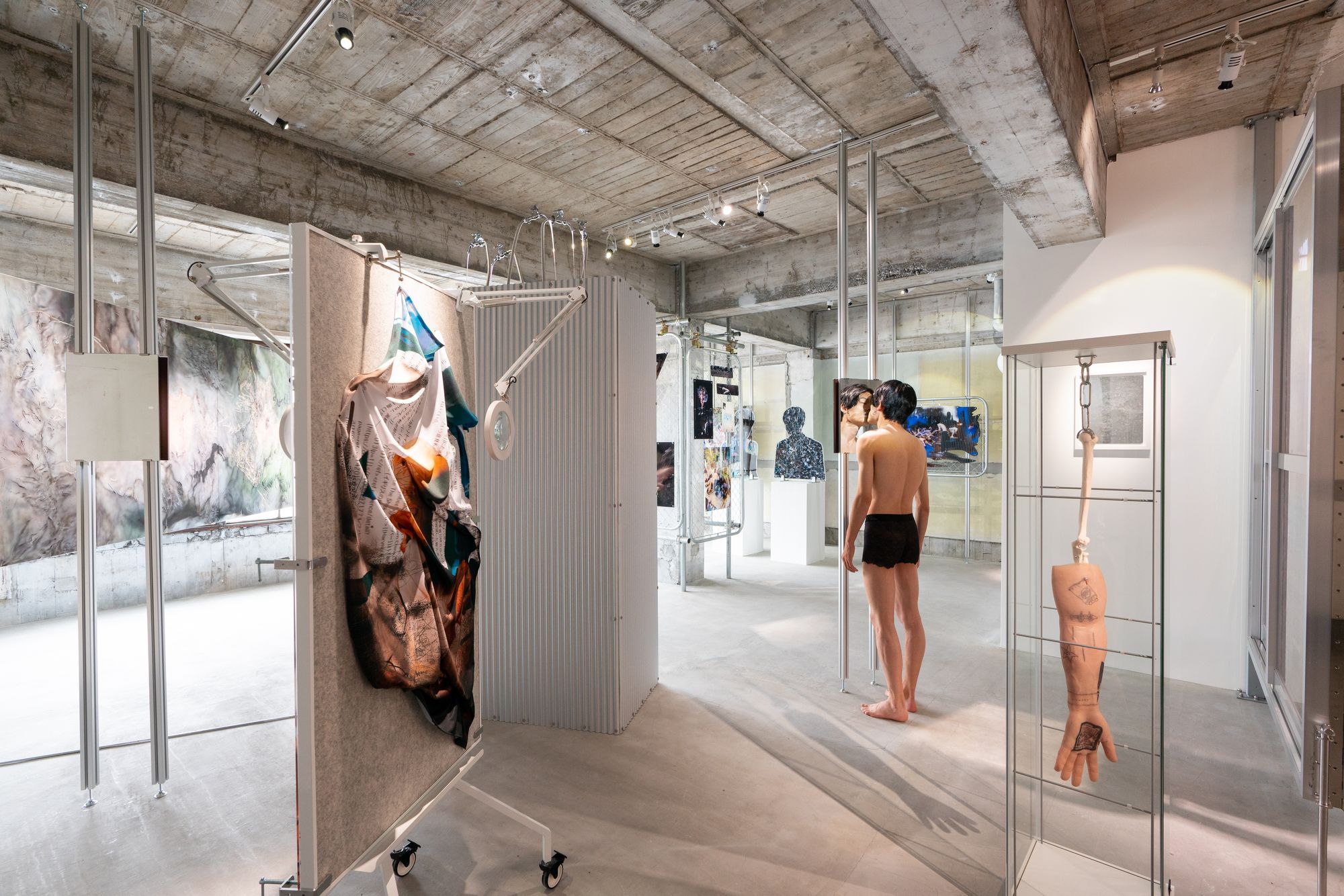
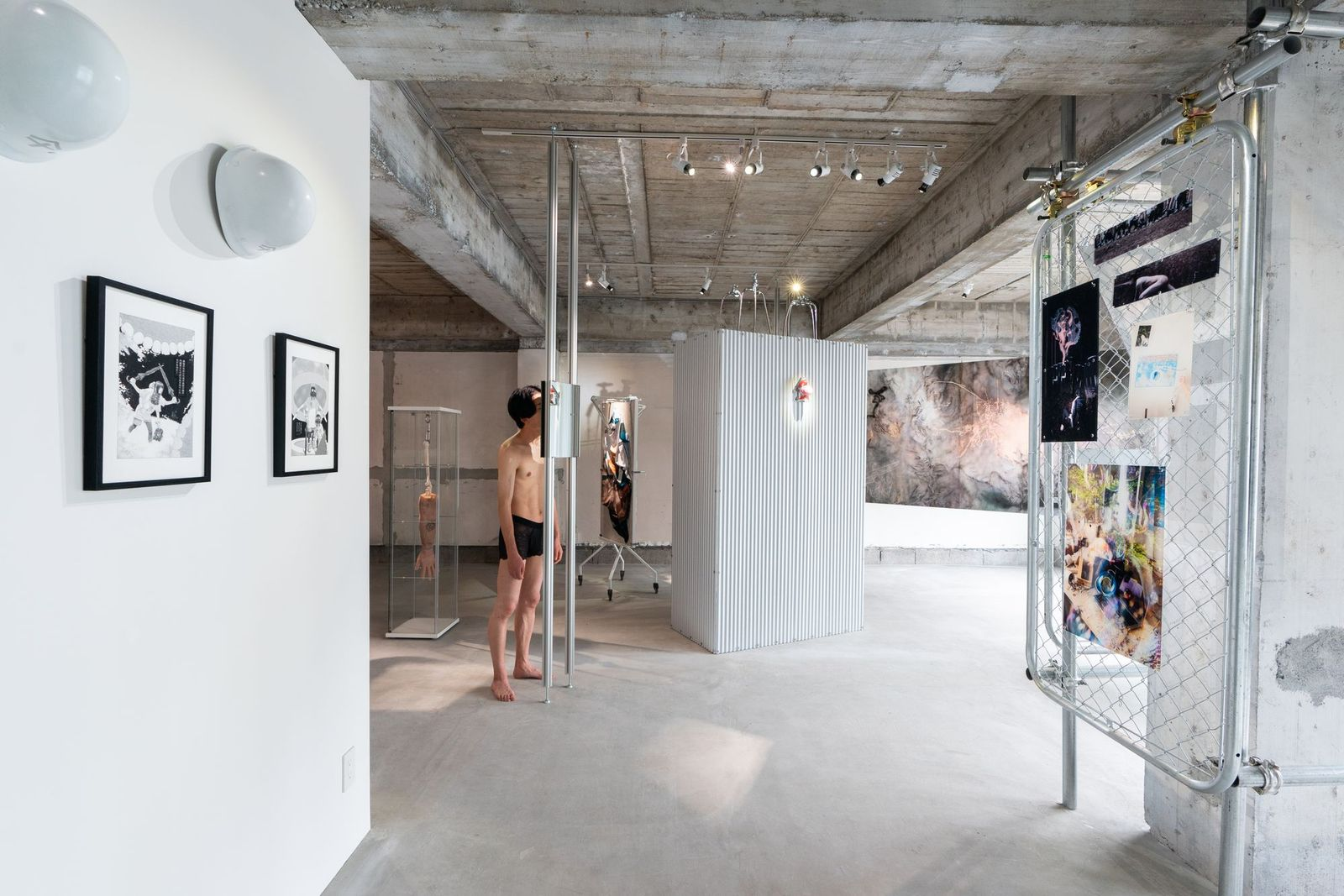
小寺創太、千葉大二郎、山縣瑠衣、BALL GAGによる展示「界面体」。集まった4人の作家は、さまざまなメディアの境界にありながら、そのどれかに閉じることも、還元されることもない。そうして界面を維持し続ける作品のコンセプトや制作過程、また、そこで得られた身体感覚はどのようなものだろうか。ざっくばらんに語ってもらった。
Text: Seshimo Shota All Photo: Naoki Takehisa
Title: 界面体 Artist: 小寺創太, 千葉大二郎, 山縣瑠衣, BALL GAG
Term: 2022.5.21(SAT) - 6.5(SUN)
Opening reception: 5.20(FRI) 18:00-21:00 at CON_
──まず、それぞれの自己紹介から始めたいと思います。自身の制作のスタイルや、今回展示する作品について簡単に語っていただけますか。
小寺創太(以下、小寺):post ill 派の小寺創太です。もともとはill 派(いる派)と名乗って、自分が展示のなかに「いる」作品をつくっていました。ただ、最近は自身の身体が介在しない作品もいいなと思うようになったので、post ill 派だなと。今回の展示では、以前やった鏡にずっとキスをし、その跡で絵画を制作する作品をふたたび制作します。あくまで絵画作品なので、これもpost ill 派っていう感じです。
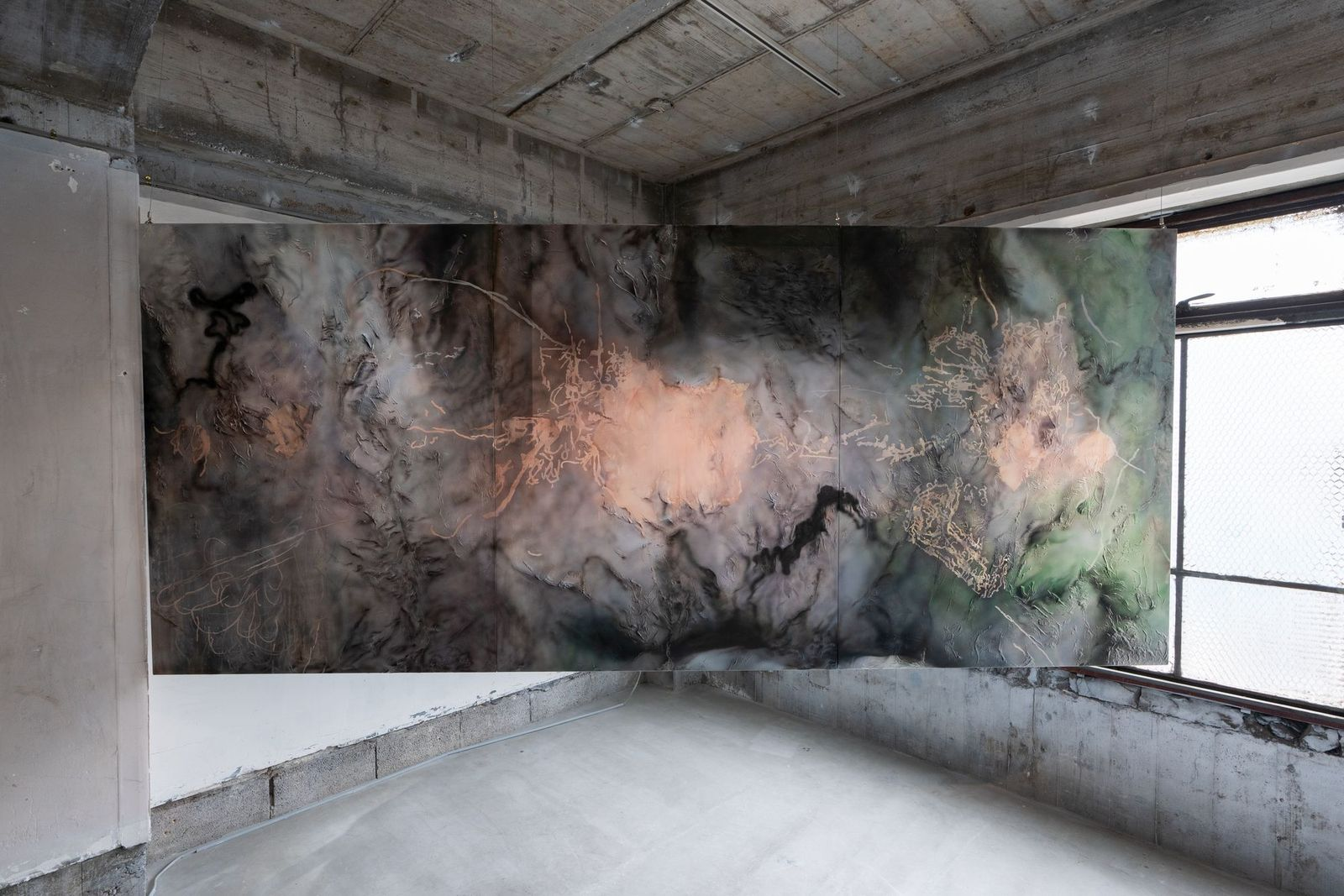
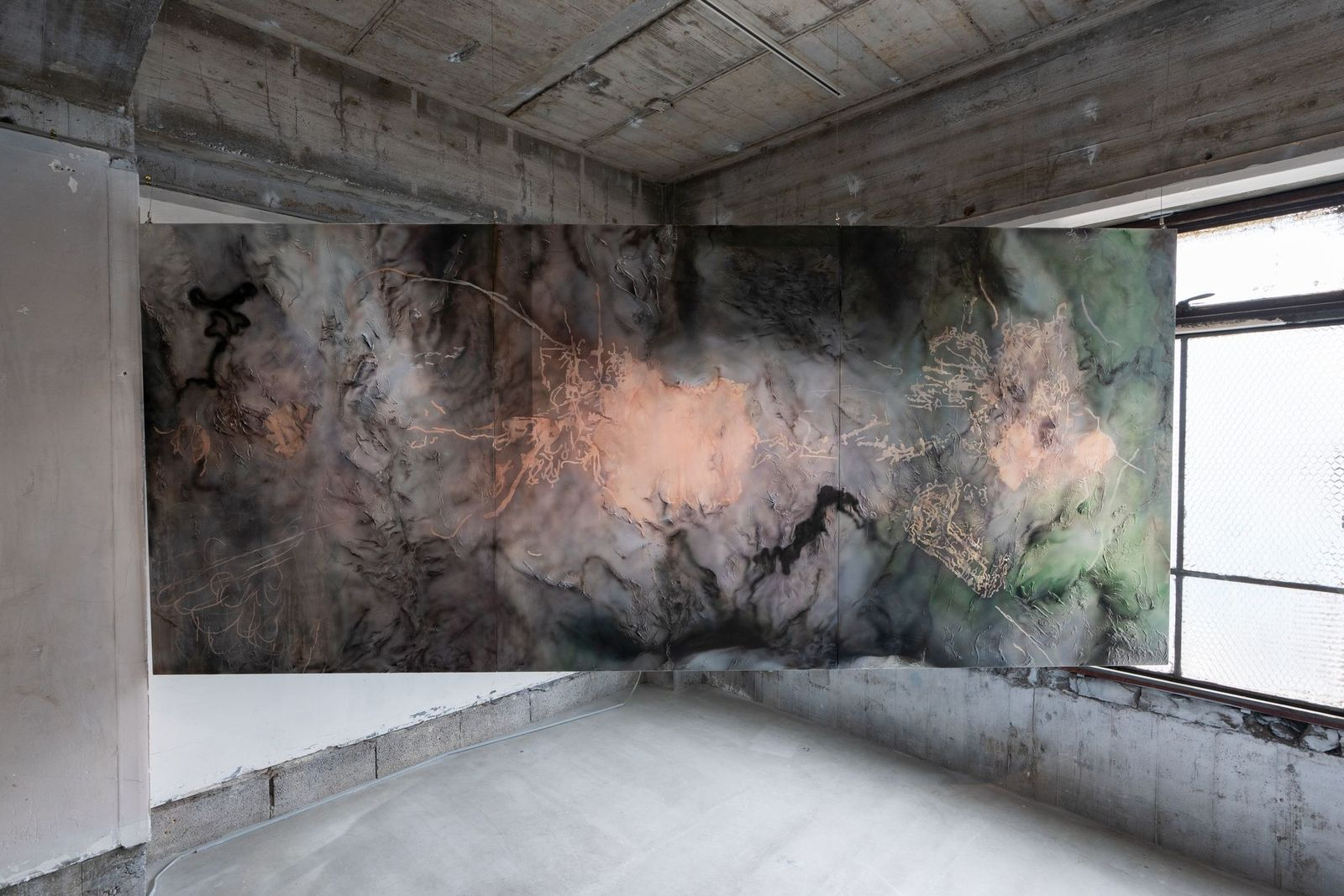
山縣瑠衣(以下、山縣):絵画を中心に制作しています、山縣瑠衣です。絵画と、描き手の身体、特に皮膚との関係にずっと関心があります。また最近では、荘園絵図や開田図のような、アイレベルの風景と俯瞰図とが織り混ざったものや、Google Mapで見られる衛星写真に関心をもっています。この展示では、そうした地図の存在から、描き手が皮膚として埋め込まれた風景描写を試みます。
千葉大二郎(以下、千葉):Hassuistの千葉大二郎です。Hassuistは、撥水教という理念を掲げています。大雑把に言うと、水を制御したり、忌避したりすることを良しと考える思想であり生活態度です。思想を展開するうえで、こうやって話したり、作品を展示したりすることを「コーティング」と呼びます。今回は果実の「桃」をモチーフに、大きい装置と漫画によるコーティングをしています。
BALL GAG(以下、BG):BALL GAGです。インターネットやスマートフォン、さまざまなメディアについて考えながら作品を制作しています。とりわけ、進化していくメディアに対して、人間は適応したり、あるいは信奉したり、どういうアクションを起こすのかに興味があって。いま制作している作品では、ウィキペディアをモチーフにして、羊皮紙のように積み重なっていく編集履歴のデータから、歴史がどのように編集されてゆくかを考えています。
[界面の周辺から]
BG:……あと、僕は展示自体が1年ぶりで、しかも、こうやって話しながら展示をつくっていくのって初めてなんですよ。芸工大時代は、アートの話ができるのって1人か2人だったし。だから、とても楽しいです。この展示に集められたアーティストは、もともとインターネットで見ていてすごいと思っていた方々で、恐縮はしますけど……。
千葉:僕は百年単位で同級生だと思ってるんで、先輩ってこともないけどね。まあ、数年単位でみるとみんな年下で、それは初めてかもしれないな。実際、展示のことをLINEでやりとりしていて、おすすめのInstagramの画像がドドドドって送られてくる感じは、脳の出来が違うなと思いましたね。
小寺:いやいや、俺もついていけなかったですよ(笑)。
──前回の展示「極薄inframince」と同じように、制作にあたってチャットなどでレファレンスを出し合ったんですか?
GILLOCHINDOX☆GILLOCHINDAE(以下、ギロチン):あ、ディレクターのギロチンです。今回もLINEとInstagramのグループをつくっています。Instagramでは、ちょうど映画『TITANE/チタン』が公開されたタイミングだったから、エグいURLも飛び交ってて(笑)。
BG:身体改造系のものとか、ちょっとやりすぎなものを送ってしまって、あとで反省しました……。そういったやりとりだと、小寺さんがジャパノイズに詳しくて、面白かったですね。
千葉:あと、本を紹介し合ったのも印象に残っているかな。本にもいろいろな種族がありますよね。僕はいつも古本屋で手に入るタイプの本を集めているから、本棚は赤茶色い感じになる。ほかの3人は新品が多くて、インプットの質が違うなと。すると、当然アウトプットも違ってくる。
BG:千葉さんからはシャーマニズム関連で、カーメン・ブラッカー『あずさ弓──日本におけるシャーマン的行為』とか、アビ・ヴァールブルク『蛇儀礼』とか。
小寺:俺は千葉さんが持ってきていたエロ本が気になった。
山縣:私は小寺さんのあげていた、幽霊論が気になりました。
小寺:大島清昭『現代幽霊論──妖怪・幽霊・地縛霊』ですね。
ギロチン:BALL GAGはZINEをいろいろ持ってきていたよね。
BG:そうですね。ほかに興味を惹かれたのは、山縣さんがあげていた身体、フェミニズム関連のものです。
山縣:カトリーヌ・マラブー『抹消された快楽』ですね。「界面体」というタイトルを浮かべたとき、音的に、まず男性器が想起されるだろうと思って、女性の海綿体について、クリトリスについて論じた同書を挙げました。
[身体と界面]
山縣:展覧会までの経緯として、Zoomで打ち合わせというか、飲み会もやりましたよね。入ったときにみんなマニアックな漫画の話をしていて、わからない…とか思いながらご飯食べてました(笑)。
そういえば告知直前の時期に、ギロチンから、今回の展示は能力者イメージでメンバーを集めていったんだって聞いて笑いました。
ギロチン:幻影旅団みたいな感じで、都市の暴力性や黒い部分を感じさせるアーティストが集まるイメージだったんですよ。大都市にあるビルの高さや電車の速さみたいな、都市がもつ暴力的な要素が好きで。
──それぞれの作品を最初に見せていただいたときは、そうした暴力性や黒さから、アングラ的な雰囲気を感じました。
BG:アングラって、あくまでイメージですけど、他者の肉体を物化するものだと思うんですよ。自分はその逆なんです。他者の肉体をもちいて表現するのではなく、自分の肉体を消費するというか、生贄のように捧げて制作している感じがする。まずは自分が血を流すところから始めるというか、自身の身体や主体性みたいなものを物化させ、アノニマス化させるんです。
ほかのみなさんも、身体を情緒的に扱っていないところが共通しているように感じます。あくまで媒体というか「界面」として扱っているような。
ギロチン:うんうん。話を聞くなかで、小寺さんのill派 - ポストill派はもちろん、BALL GAGも、山縣さんも、千葉さんもそれぞれが自分の身体にかかわる表現をやっていることが重要に感じられてきた。
──そこからコンセプトも生まれたんですか?
ギロチン:そうです。あとで本人に話してもらいたいですが、今回も出展されるBALL GAGの写真シリーズに「界面」というのがありまして。そこに身体的なニュアンスをくわえて、「界面体」という展示のタイトルができました。
小寺:俺はさっき話した鏡にキスをやるつもりだったから、ちょうどいいと思った。鏡だから、まさに界面っていう。
山縣:私もそうです。世界に面しながら絵を描いている身体に関心があるから、すごく近いし、嬉しいなって。
[狭いインターネットと編集合戦──BALL GAG]
──ここからはそれぞれの作品について語っていただきたいと思います。先ほど話題に出た、BALL GAGさんの写真作品からいきましょうか。
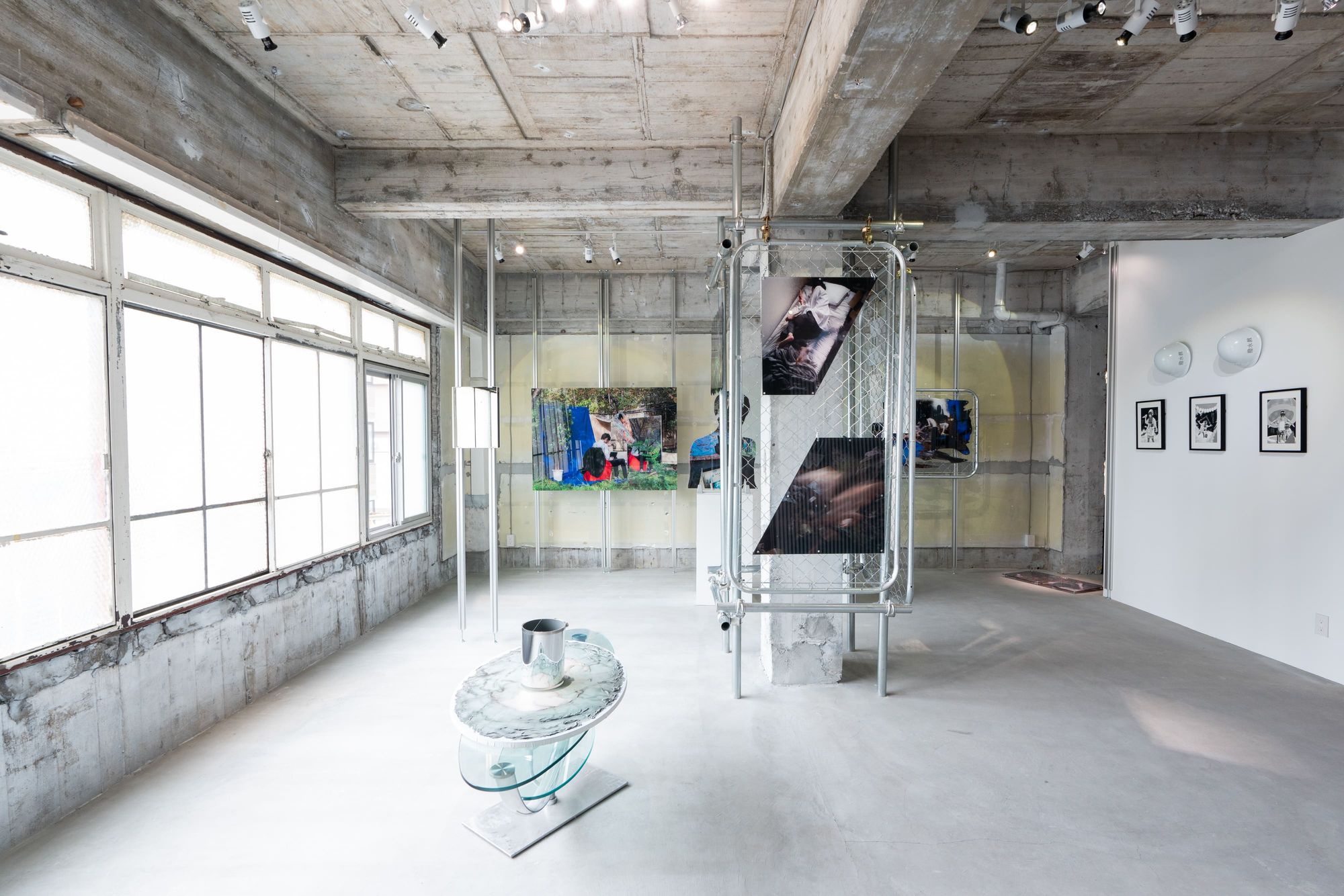
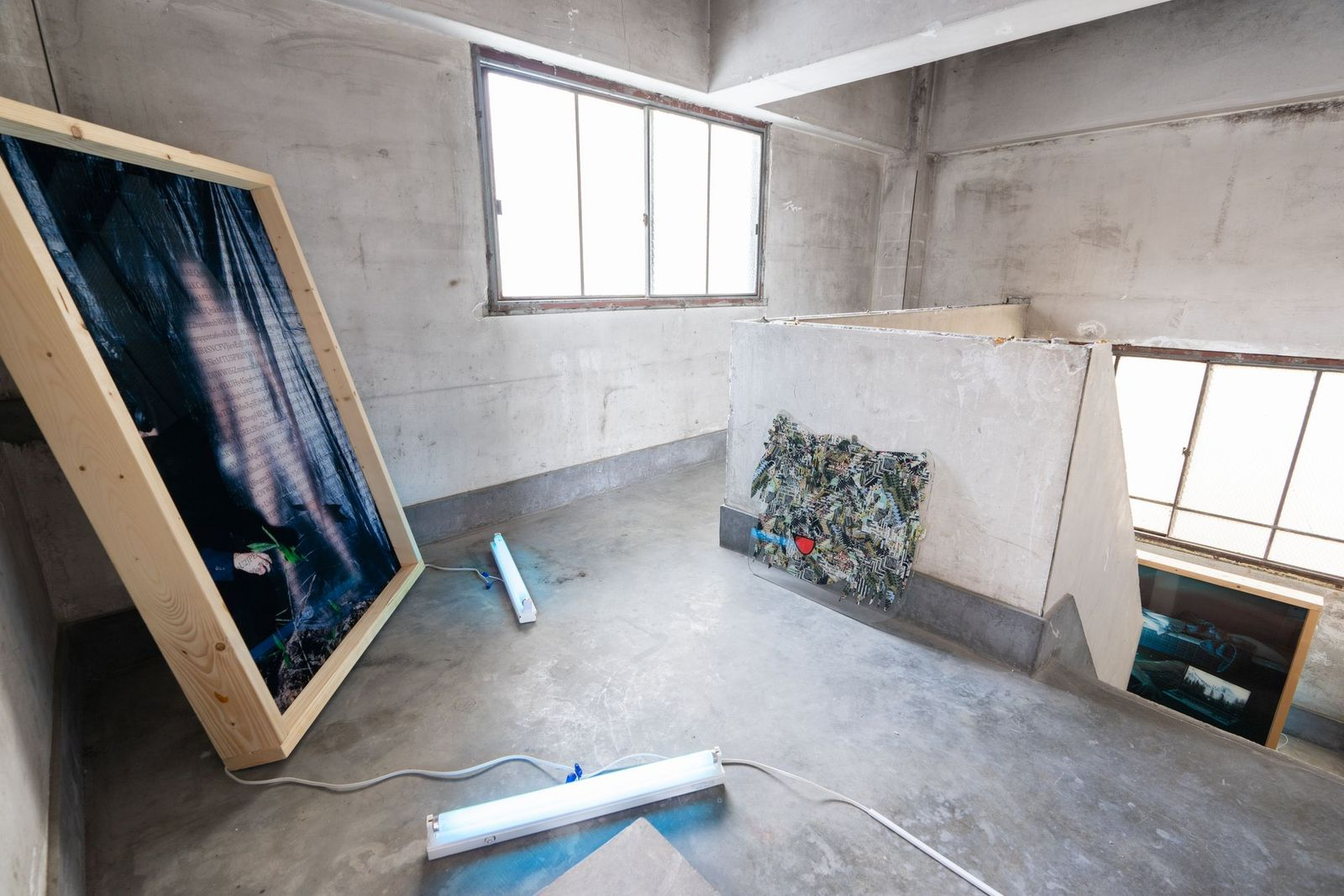
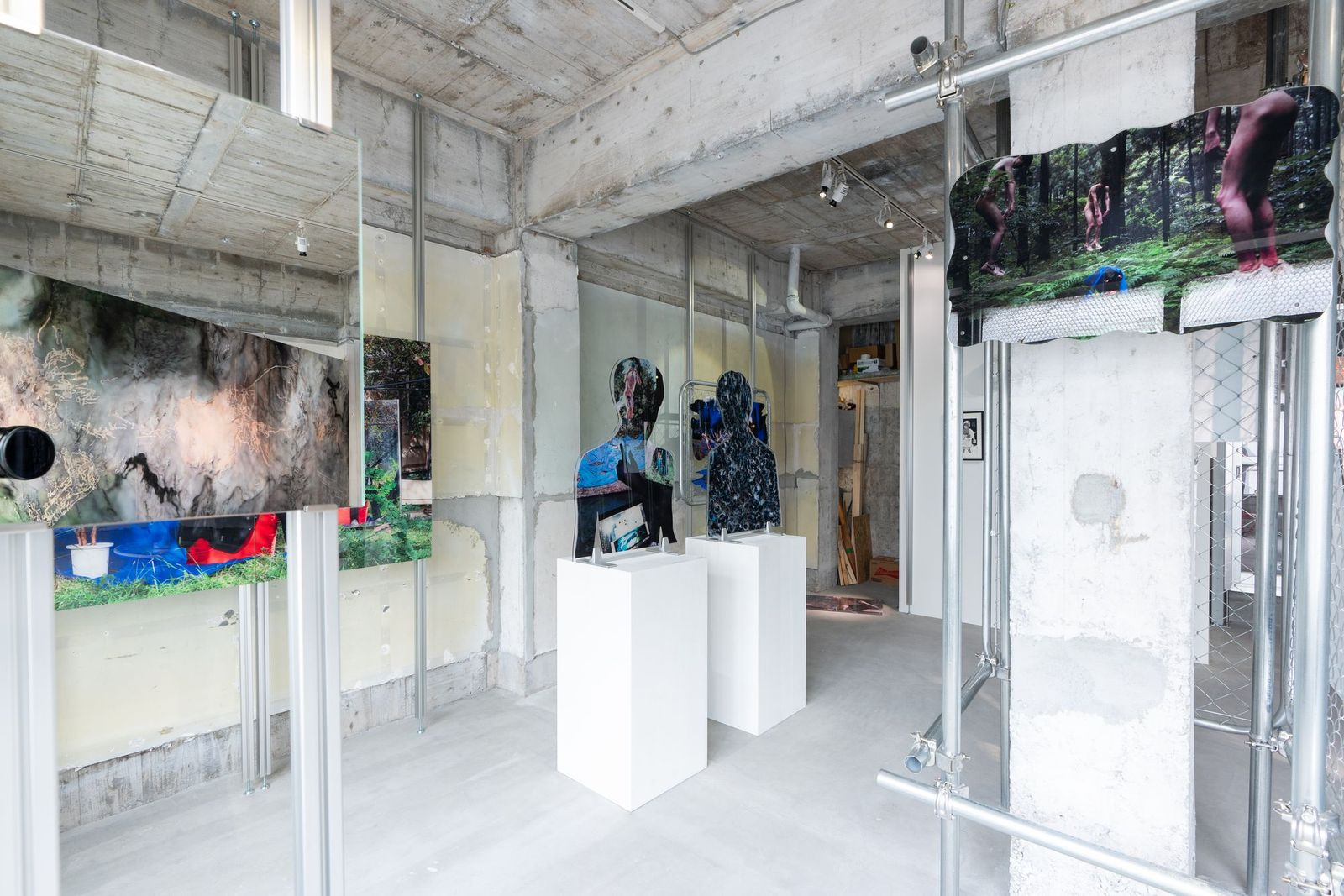
BG:はい、写真作品シリーズ「界面」は、コロナ以降の自分とネットの関係性を振り返りながら制作した作品です。自分の部屋にこもって、感染症や社会情勢についての情報をSNSで得ていた体験から、場所と共同体、他者について考えたものです。
まず登場するのは、全裸の人間です。この人物は、SNS上にいるような顔が見えない存在です。次に服を着た人間は、どのコミュニティにも所属していない存在。場所を往来するにつれて、服がだんだんとはだけ、全裸になっていきます。
風景のほうに目を移すと、全裸の人間と服を着た人間は、内と外、個室の部屋と森に対応しています。森はサイバースペースの隠喩で、外でありながら閉鎖的な場所です。主体はなく、そこには客体化された植物たちだけがいる。
──社会的なテーマを扱った作品なんですね。
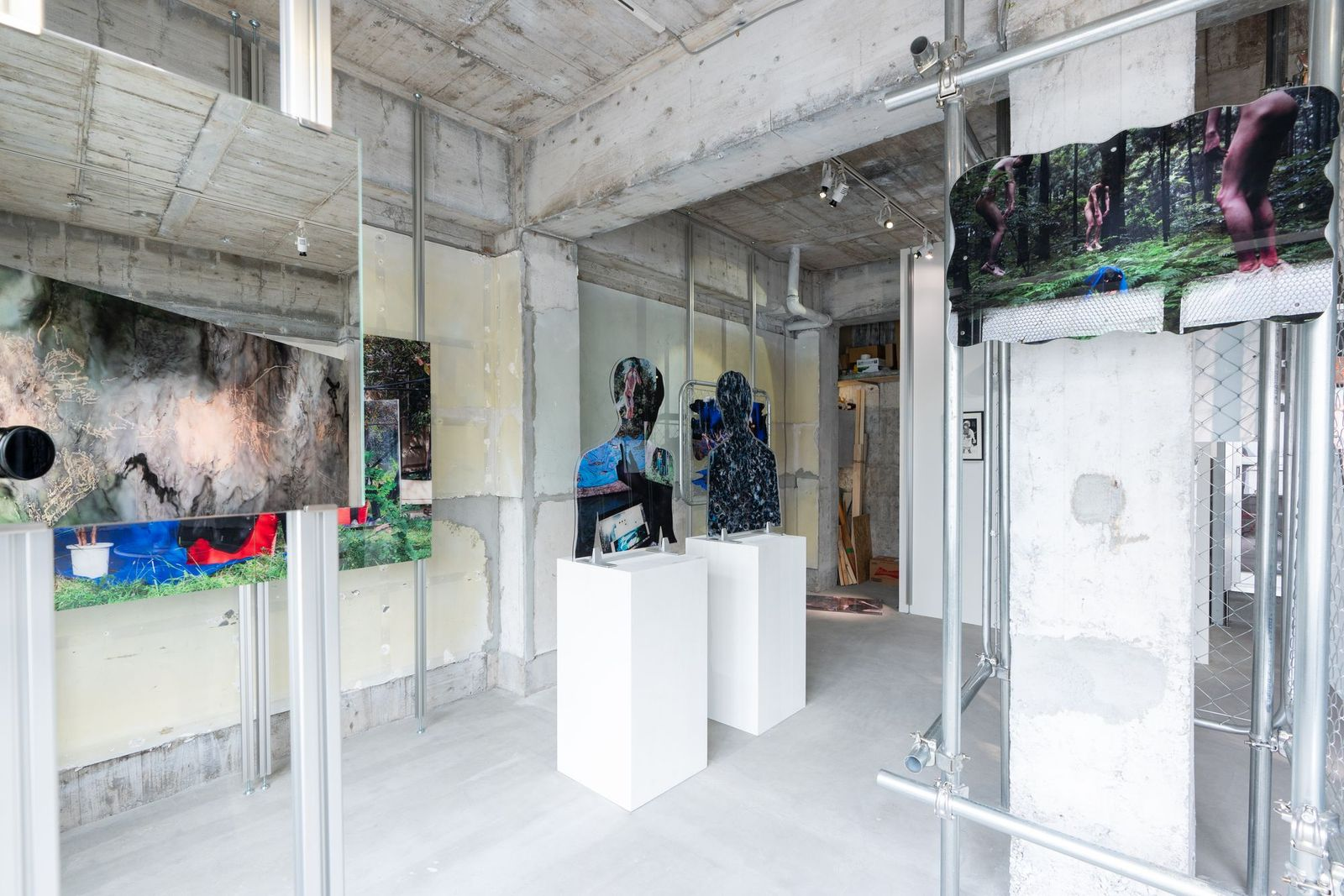
BG:SNS上の個人間で起こる、小さなナショナリズムがテーマなんです。そこでどんな人々に出会うかって、偶然的なもののように見えて、プラットフォームによる恣意的なものです。そんな恣意的な選択によって集まったアカウントが、群島化していく。狭いコミュニティに属して、客体に主体を投影したり、出来事を真実として構成したり。そこには若者の政治観というか、局所的で、閉鎖的な社会のイメージが反映されている。
──興味深いです。次に、この文字がたくさん書かれた作品は、どういうものですか?
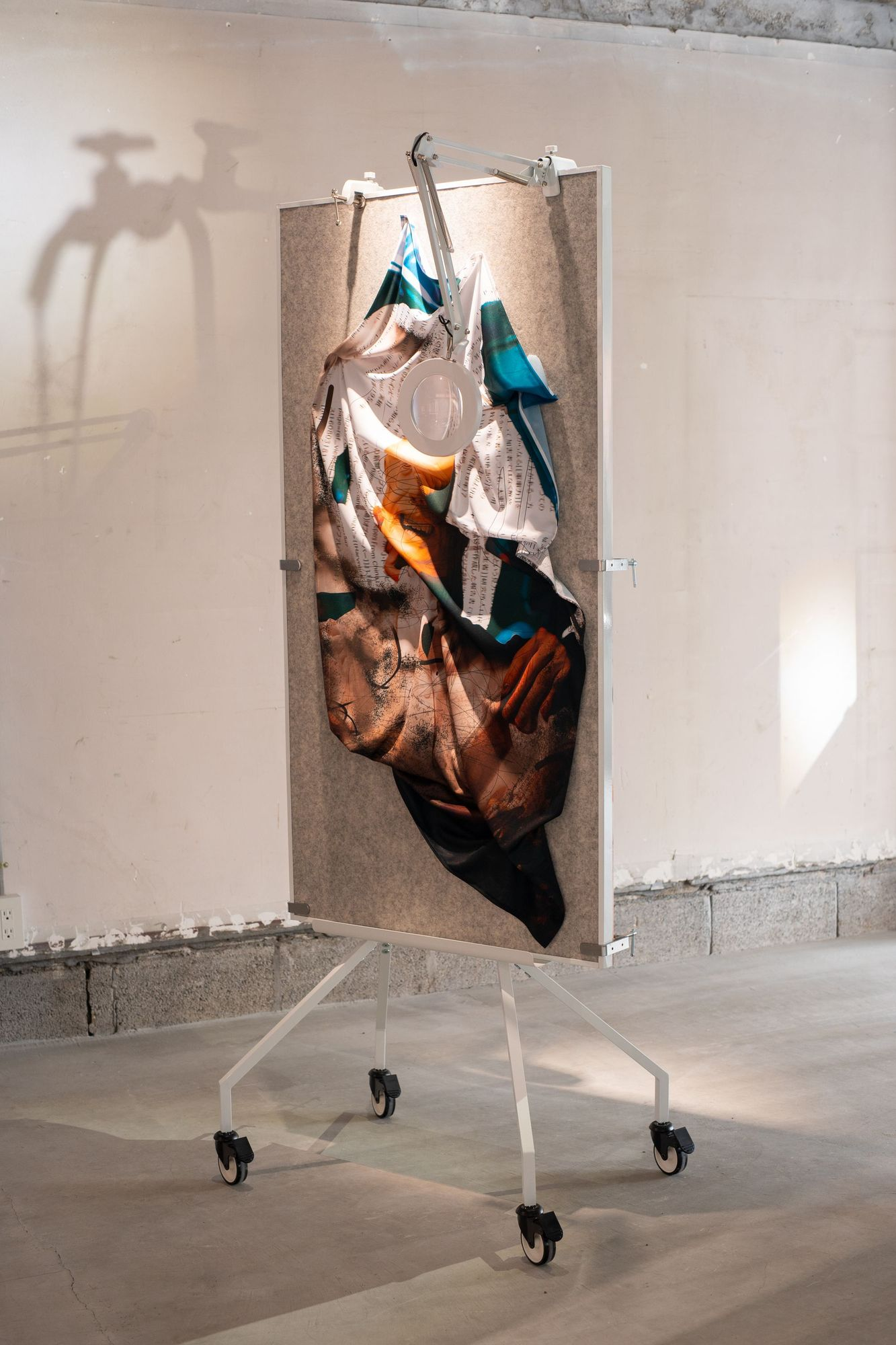
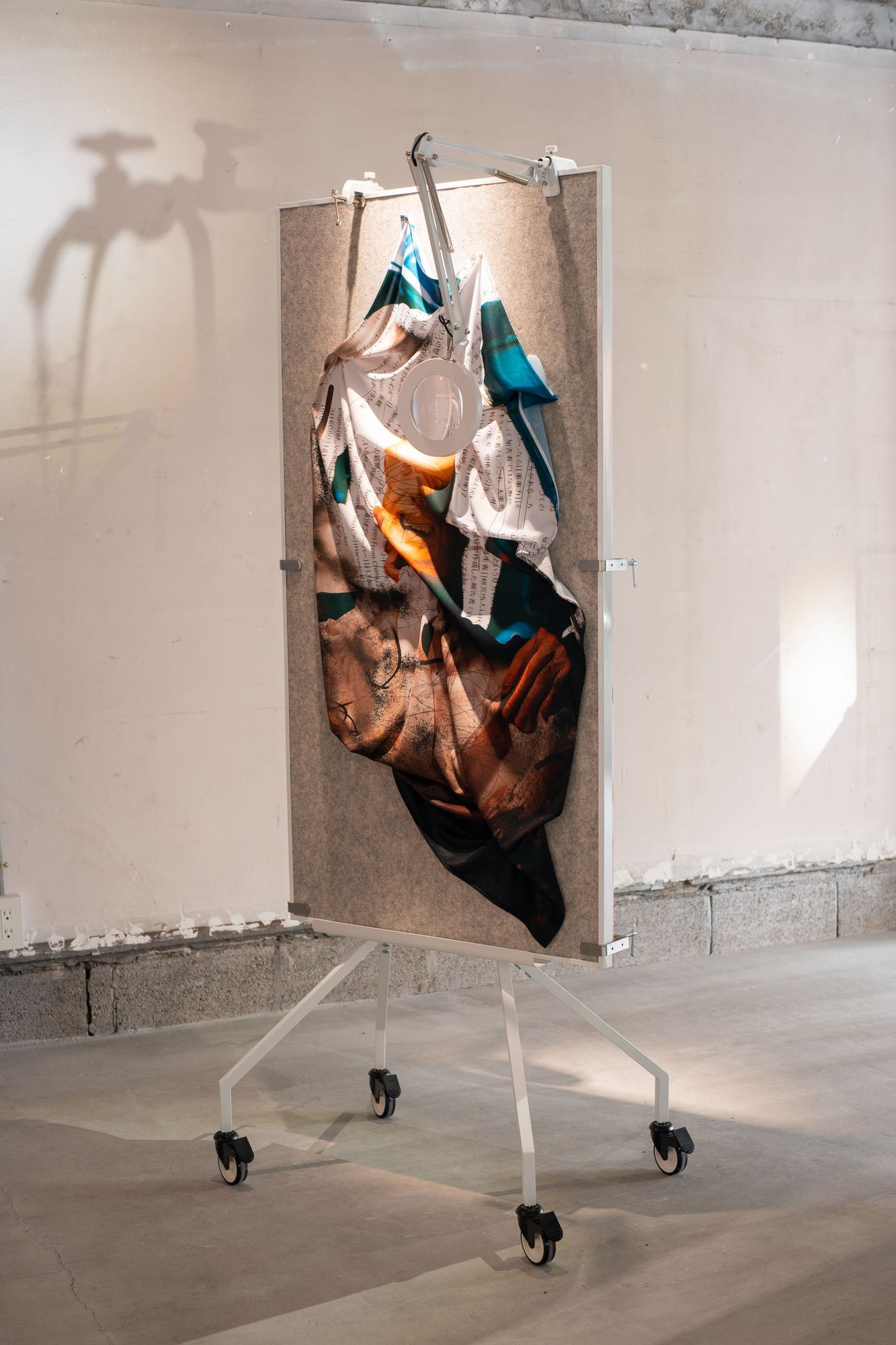
BG:これはパリンプセストといって、書かれた文字を一度消して、別の内容を上書きした羊皮紙の写本が題材です。一部しか見つかっていなかった聖書や、アルキメデスの法則がパリンプセストから復元されるなど、歴史的に重要なものもあります。パリンプセストを知ったとき、自分はウィキペディアを思い出しまして、この作品を制作しました。
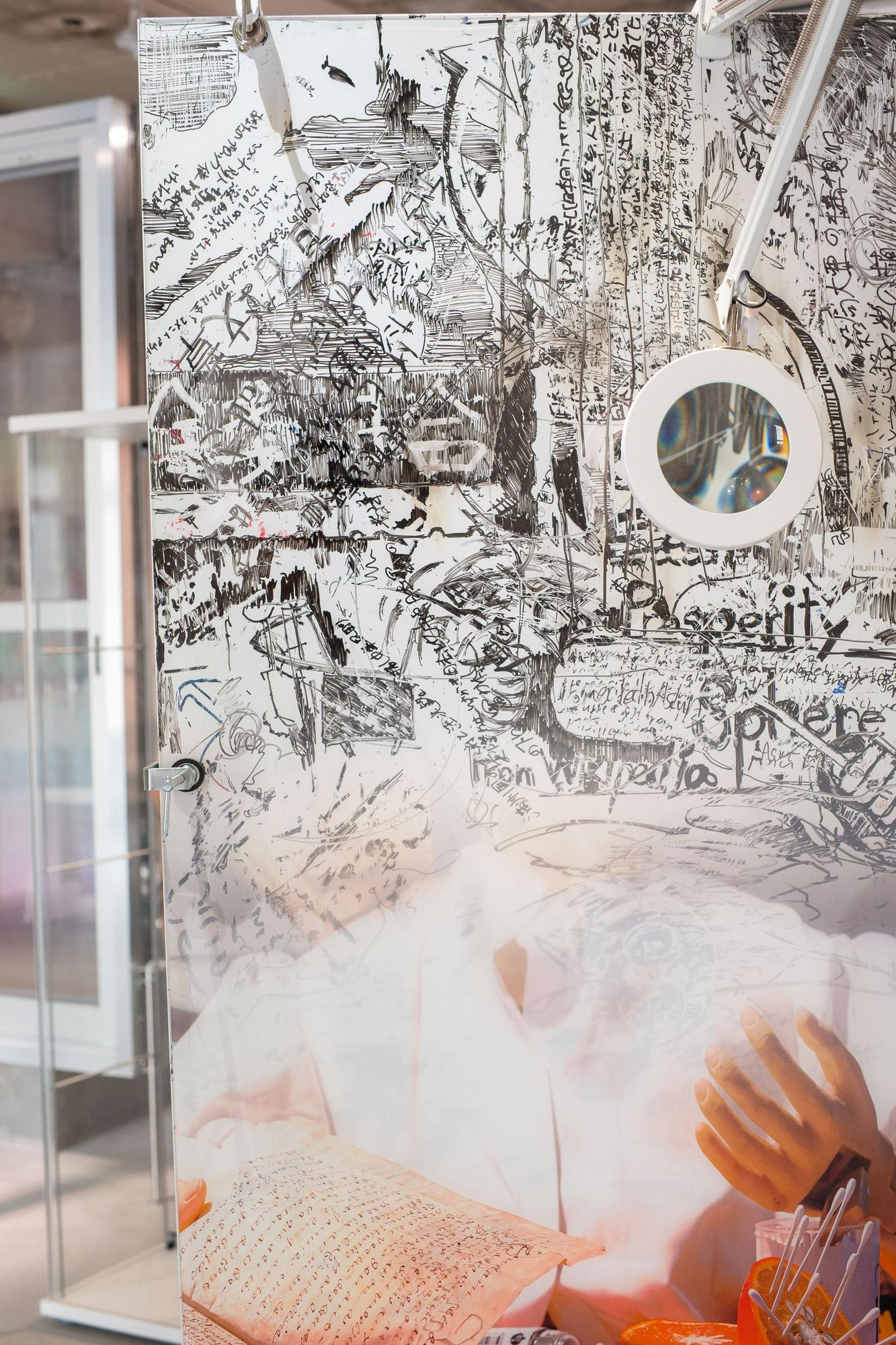
ホワイトボードに書かれている文字は、ウィキペディアの編集履歴です。内容としては、第二次世界大戦中に日本がおこなった、アジアでの植民地政策にかんするものですね。編集履歴には、植民地政策がアジアの解放につながった、日本はアジア圏のリーダーだったんだと考える人と、植民地化は正当化すべきでないと考える人との編集合戦の記録が残っています。レスバトルみたいですよね。ホワイトボードに文字を書いては消し、書いては消しという感じでつくっています。
隣には、これを書いたり、消したりする人が収められています。IKEAやAmazonで買ったミニマルな素材で、石碑のようなものとして自立させています。制作を通じて、現代における歴史の編集と、それがどこに残るのかを考えています。言ってみれば、記録がデータとして残る時代のパリンプセストがテーマですね。
山縣:モノとしてのかたちが面白いですよね。「(履歴は、地層となりてます)〜それはまるで。とてもパリンプセストです!!!!!〜/(拭いたりて、地層を回廊せしめる)〜あれは引き上げる。ボーリングだったのです⁇⁇?〜」はホワイトボードも剥き出しで使わず間に1枚挟んだり、「界面」はアクリルフレームで透け感を出したり。
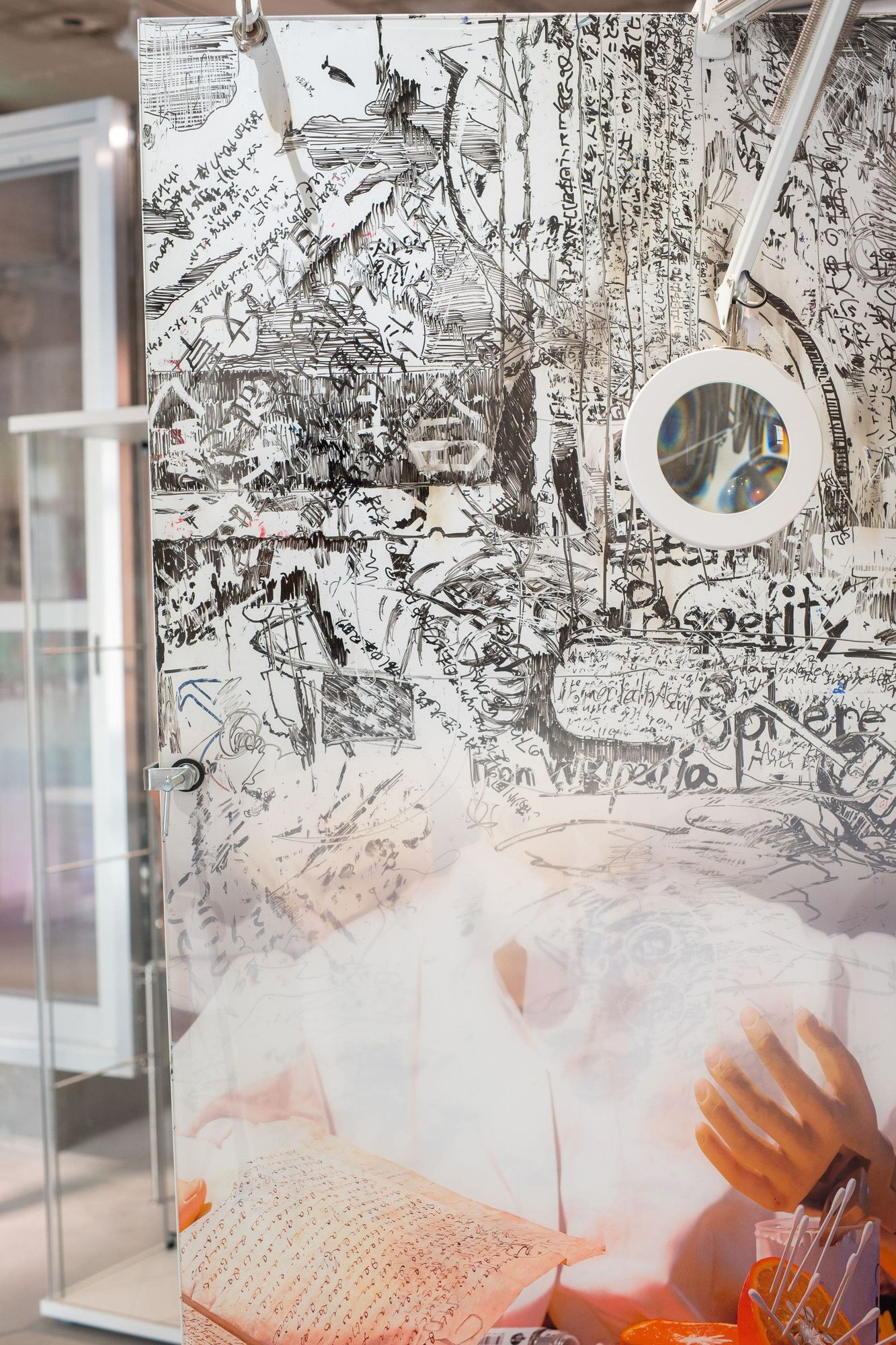
BG:自分の匂いを消したいんですよね。絵画を描いているときなんかに、マッチョで、男臭い部分の自分が出てきて嫌だなあと感じることがあって。「界面」については、スマホの世界とのつながりという意味でアクリルを選択したところもありますが。一番大きいのは、作品からなるべく自分を脱臭したい、距離を取りたいっていう。そのために写真を使ったり、アクリルを使ったり、薄い媒体を積極的に選んだりしているところがあるかもしれません。
["沈まない桃"のコーティング──千葉大二郎]
──続いて、千葉さん作品の紹介をお願いします。
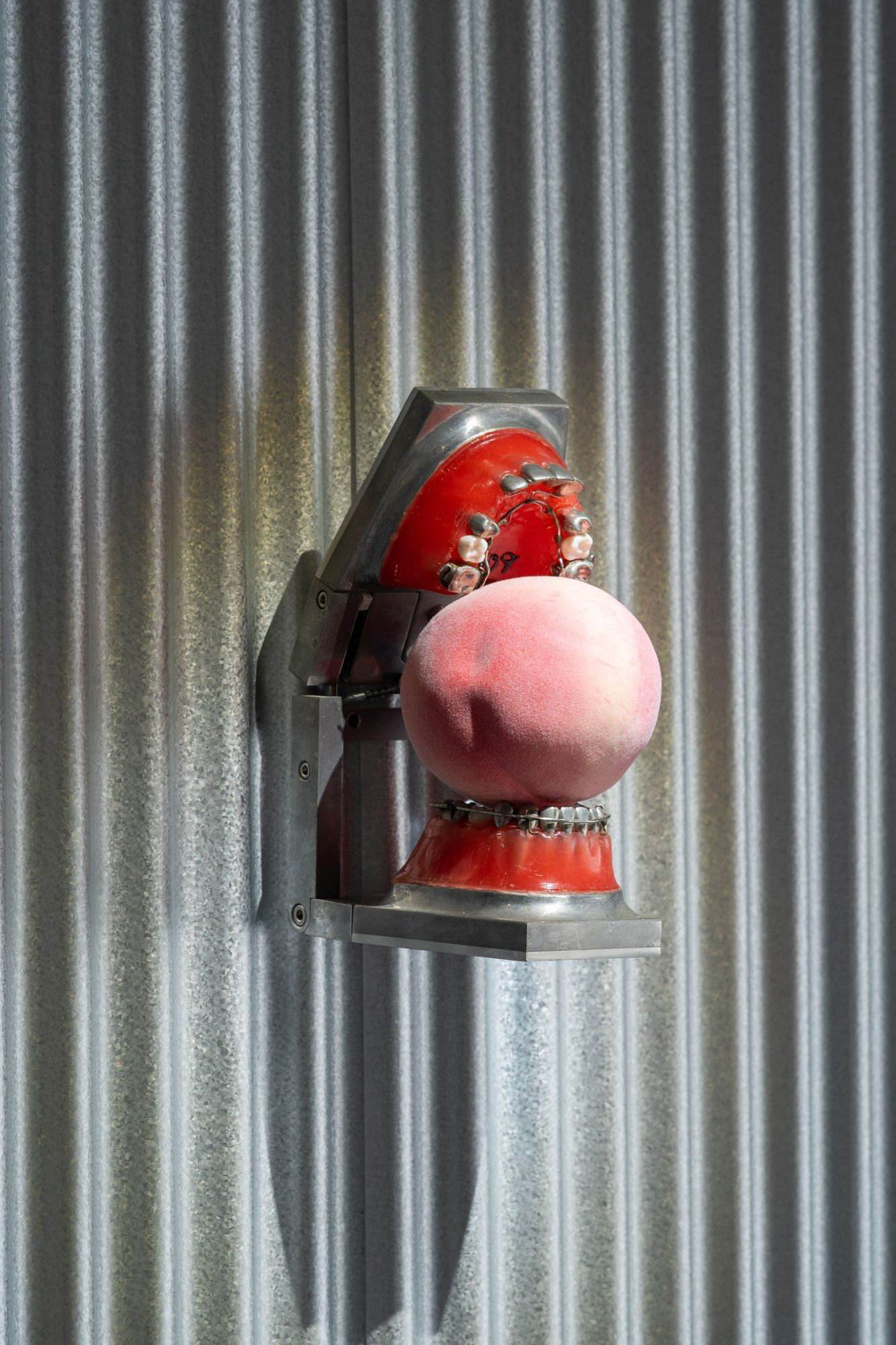
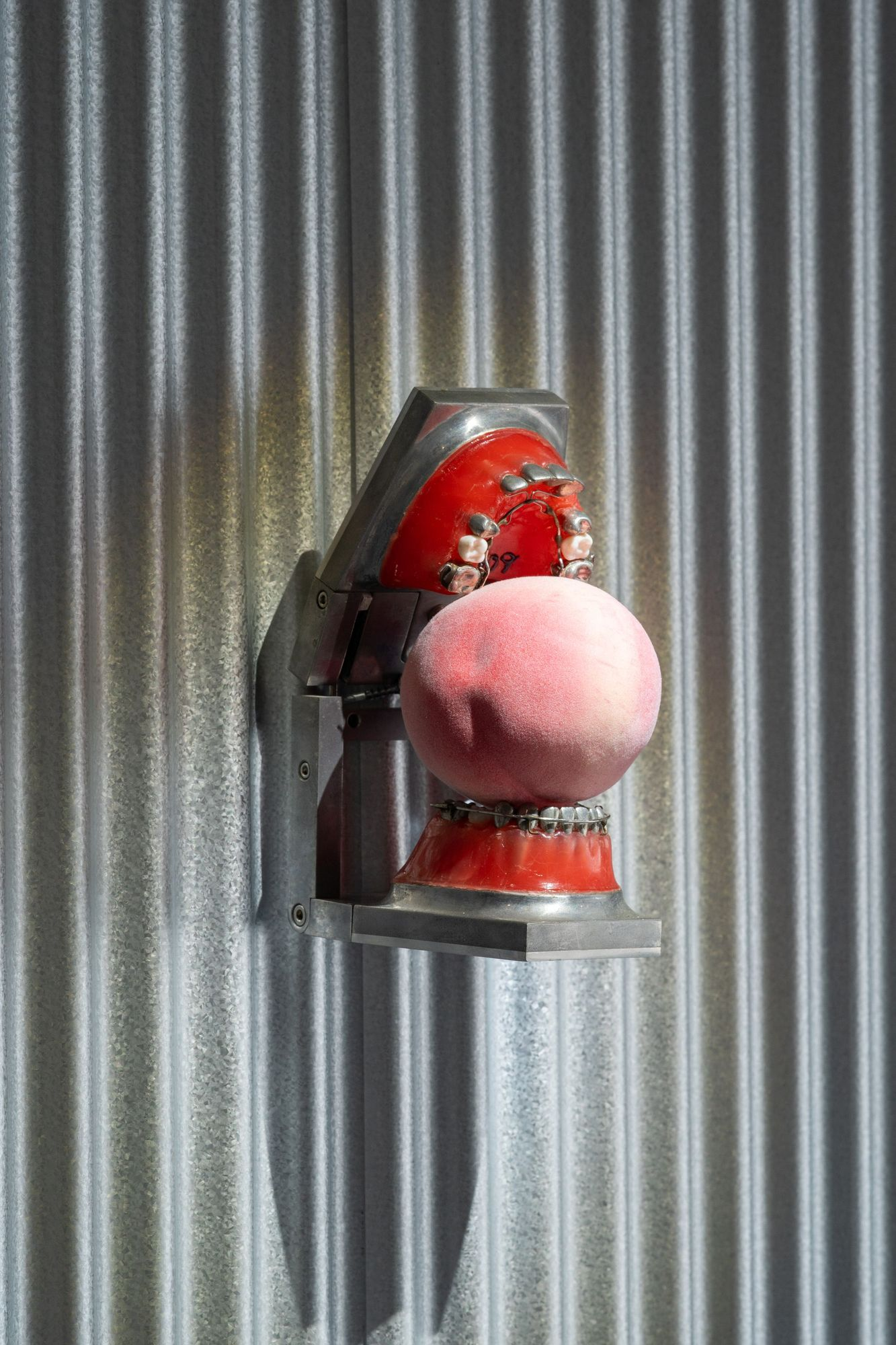
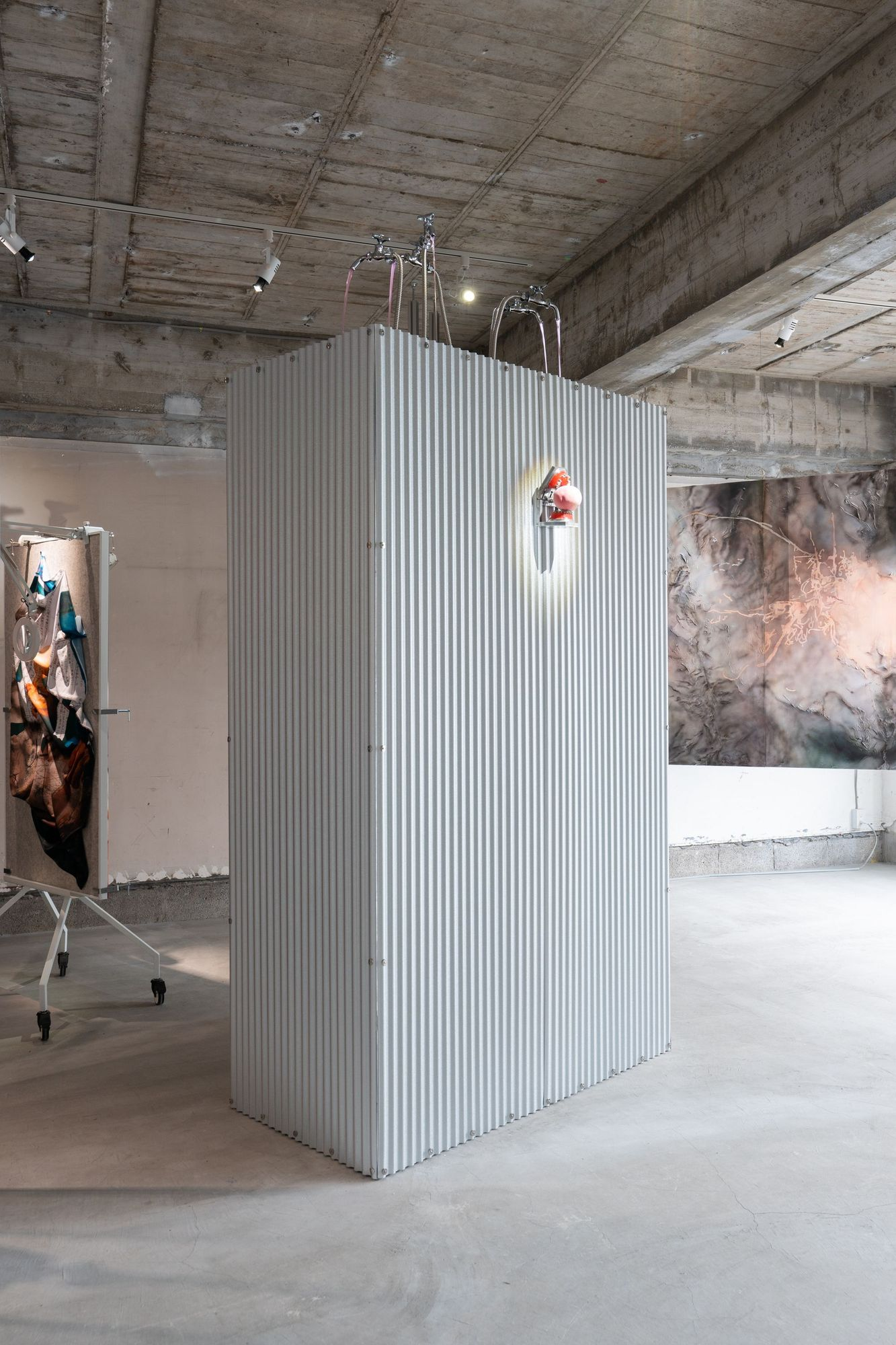
千葉:今回のコーティングは「桃」です。"沈まない桃"をモチーフに、シャワールームと漫画のようなイメージを制作しました。
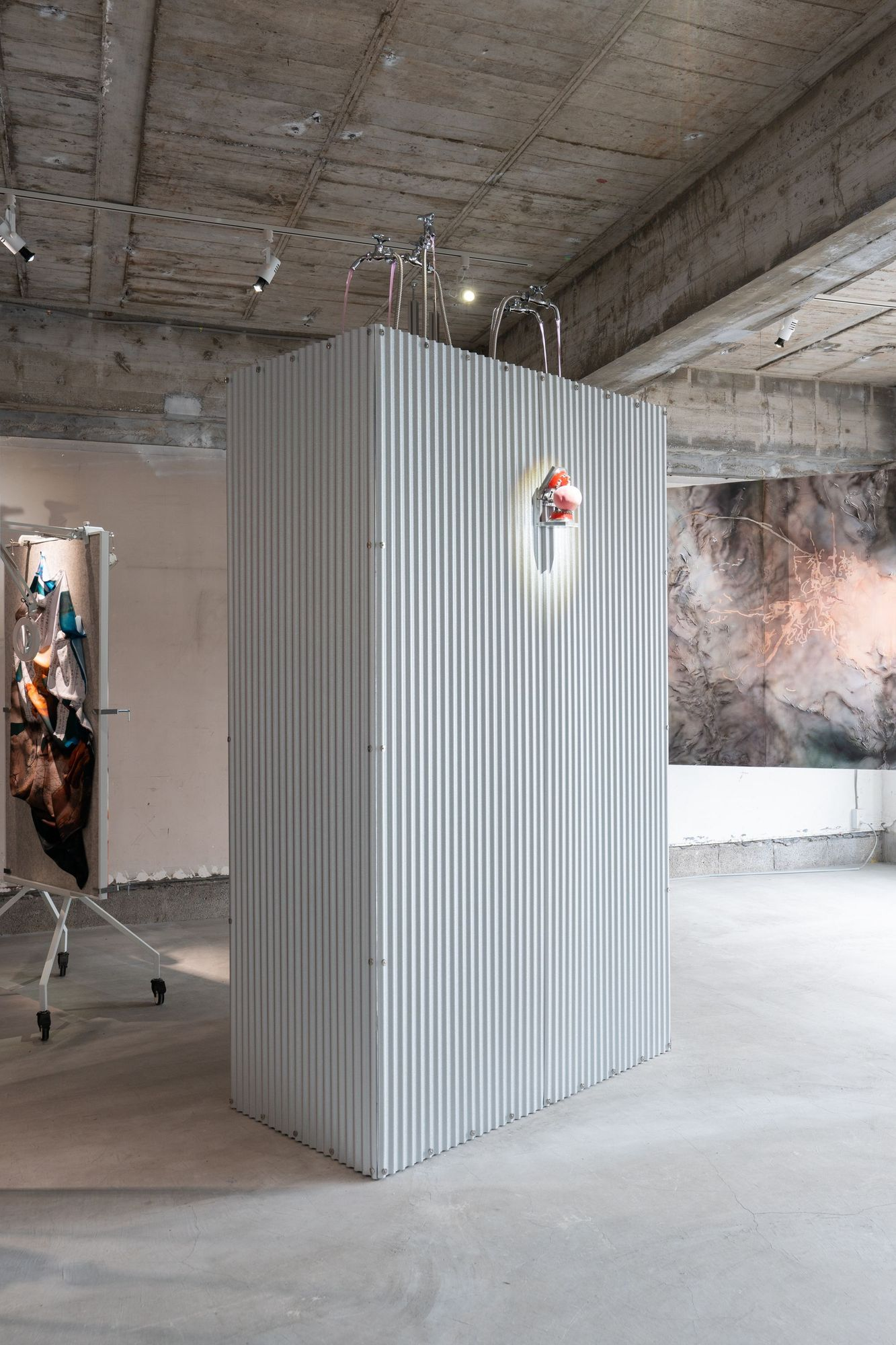
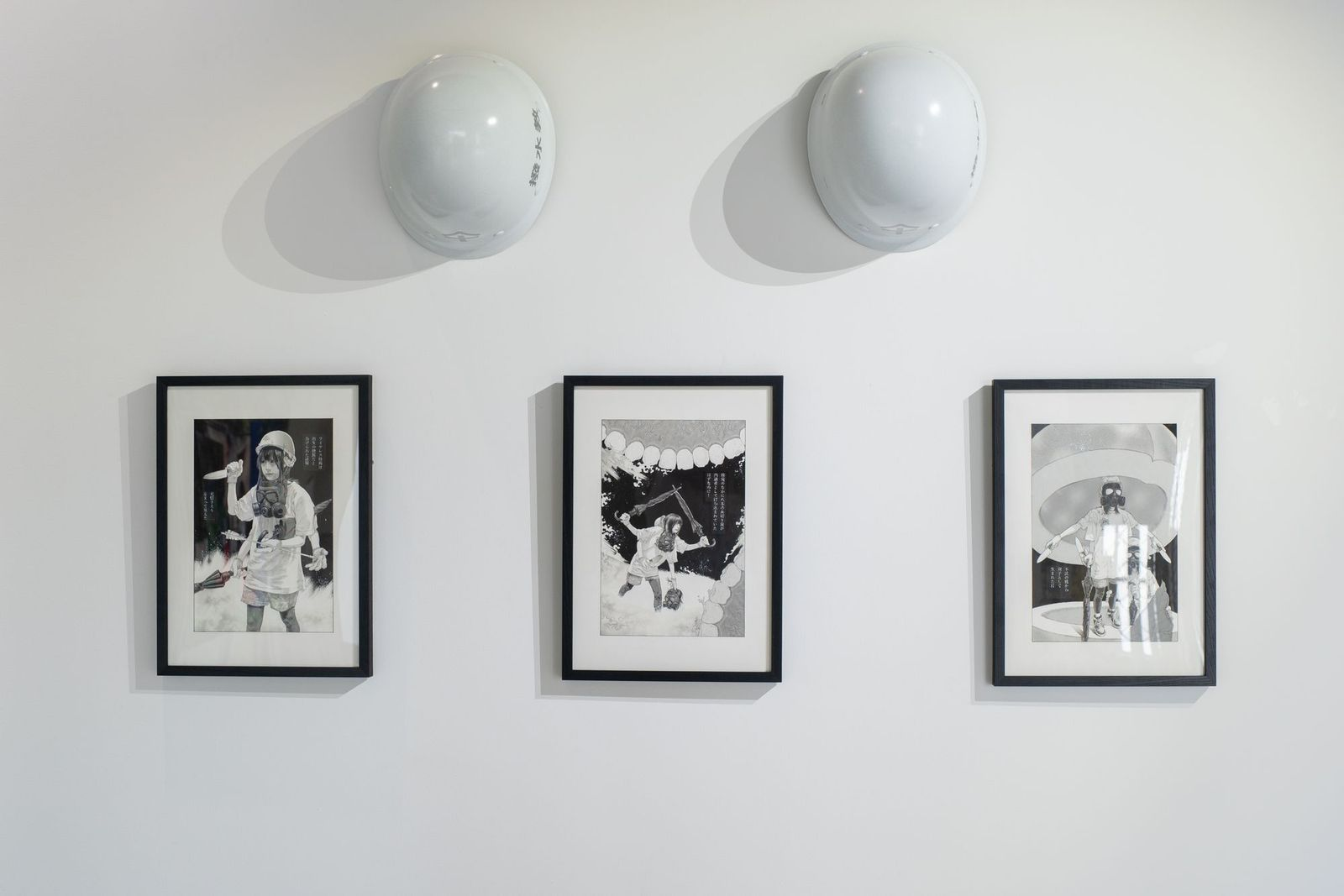
まずシャワールームのほうは、言ってみれば懺悔室ですね。キリスト教的なきらいがある言葉だから、もし避けるとすると、反省室かな。部屋の内部は見えなくなっていて、中から蛇口が天井近くまで伸び、そこにとろとろした桃色の液体が循環している。この反省室は、桃が割られて人間が生まれてくるように、何度も何度も生きながらにして生まれ直す装置です。
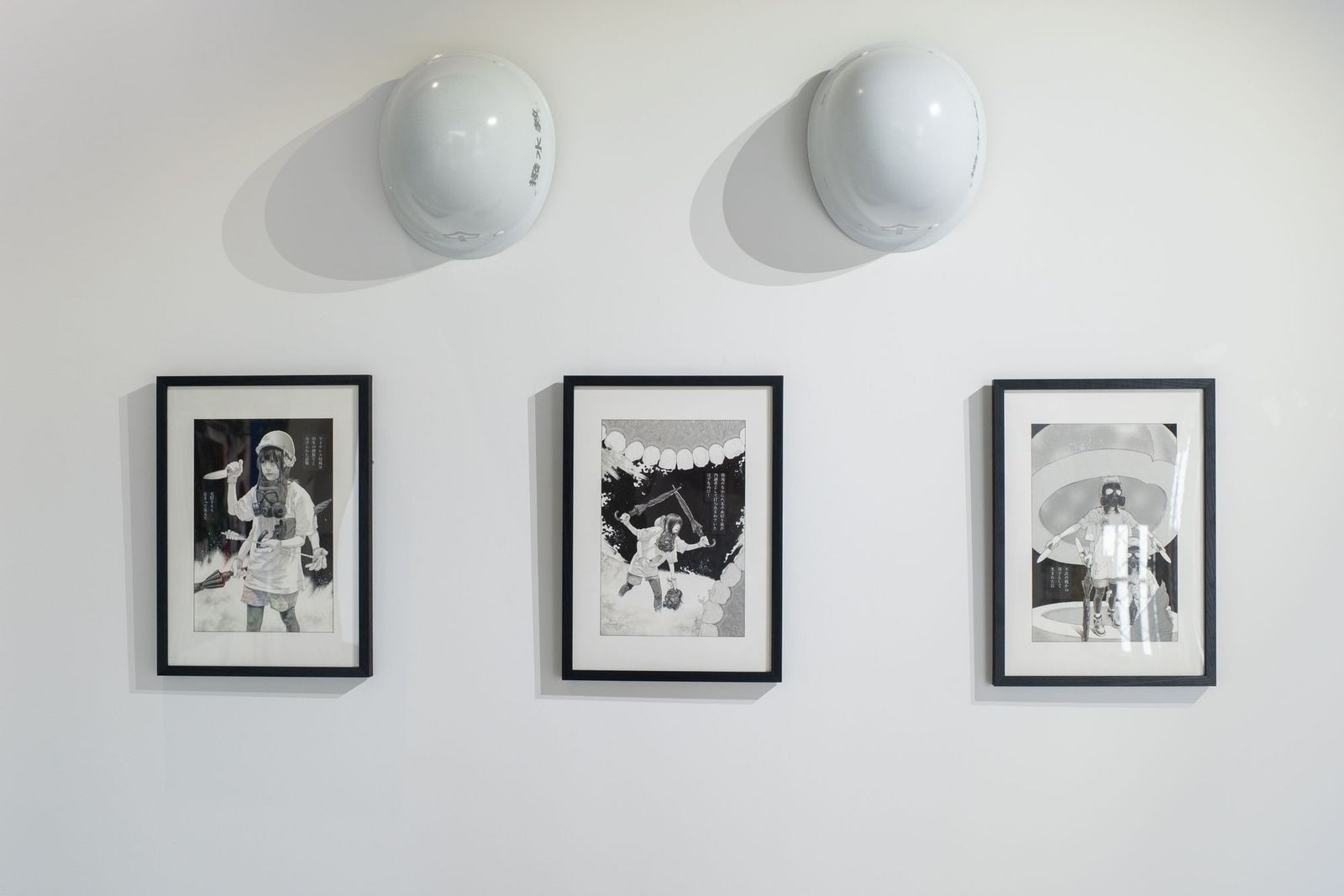
次に漫画のほうは、先の作品を補足するように、イメージやシーンが描かれています。桃を自分で切り開き、アメンボのような六肢の双子が生まれてくる姿があって、そのあと歯型のようなものに噛み砕かれて、ひとりは死んでしまって。
──こうした装置や漫画によるコーティングは、以前からおこなっているものですか?
千葉:まあ、そうですね。ただ、決まりきったものというよりは、実際にやっているなかで、コーティングの方法を試しているなかで出てきている感じです。
装置については、最近で言うと、大きい水車みたいな作品をコーティングしたことがありました。その作品は、最初水板が白だったんだけど、よく伝わらないと思って赤にしたら、裏返った口腔のようなイメージになった。すべてを巻き込む死の歯車ですよね。水車の周りには舞台があって、そこで撥水教義をもとにしたセリフを叫ぶたびに、僕がずりはいからはいはいになって、よちよち歩きになって、直立するという動きを繰り返します。この動きも初日には思いつかなくて、ずっとずりはいだけしていて身体中がボロボロになった。
漫画についても似たところがあります。漫画は以前は描いていなくて、涅槃図の前で坊さんが仏教の世界観をひとつひとつ解説するように、コーティングと称して僕自身が作品を説明していた。でも、展示会場に常にいるわけじゃないから、あるとき漫画を使おうと思い立った。漫画は文章とイメージが一体になっていて、みんなに親しまれているフォーマットで、ステートメント代わりにもなるし、作品にもなる。もともと漫画家になりたかったこともあって、展示のときにはいいコーティングだなと。
BG:千葉さんは「硬軟」のようなユニット名もあれば、撥水教、Hassuistといった立場も打ち出していて、いろいろ名前がありますよね。そのこともあって、謎めいた印象があって。作品にも危うさとエネルギッシュなところが同居しているように感じます。
千葉:そんなこと言っていただいて、ありがとうございます。どうしてそうなってしまうかと考えれば、直感を大事にしていたり、過程をすっ飛ばして答えにたどり着いたりするからかもしれない。今回の作品に登場する「双子」で言えば、対になるものをぶつけ合わせるとか、そこから第三のものが登場するとか、そういうことが重要だという直感があったからだし、「硬軟」で言えば、日本画材屋にしか用のないような日本画専攻の人間が、ホームセンターに行ったほうが創作意欲が湧くと思ったら近くに「コーナン」がたまたまあったから。でも、後から考えると、その名前に存在のあり方が表れている。逆に言うと、いろいろな制作や出力、コーティングは、その名付けに対する確認であり、答え合わせの作業だと思っています。
[Googleマップを見る身体、絵画を描く身体──山縣瑠衣]
──続いて、山縣さん作品の紹介をお願いします。
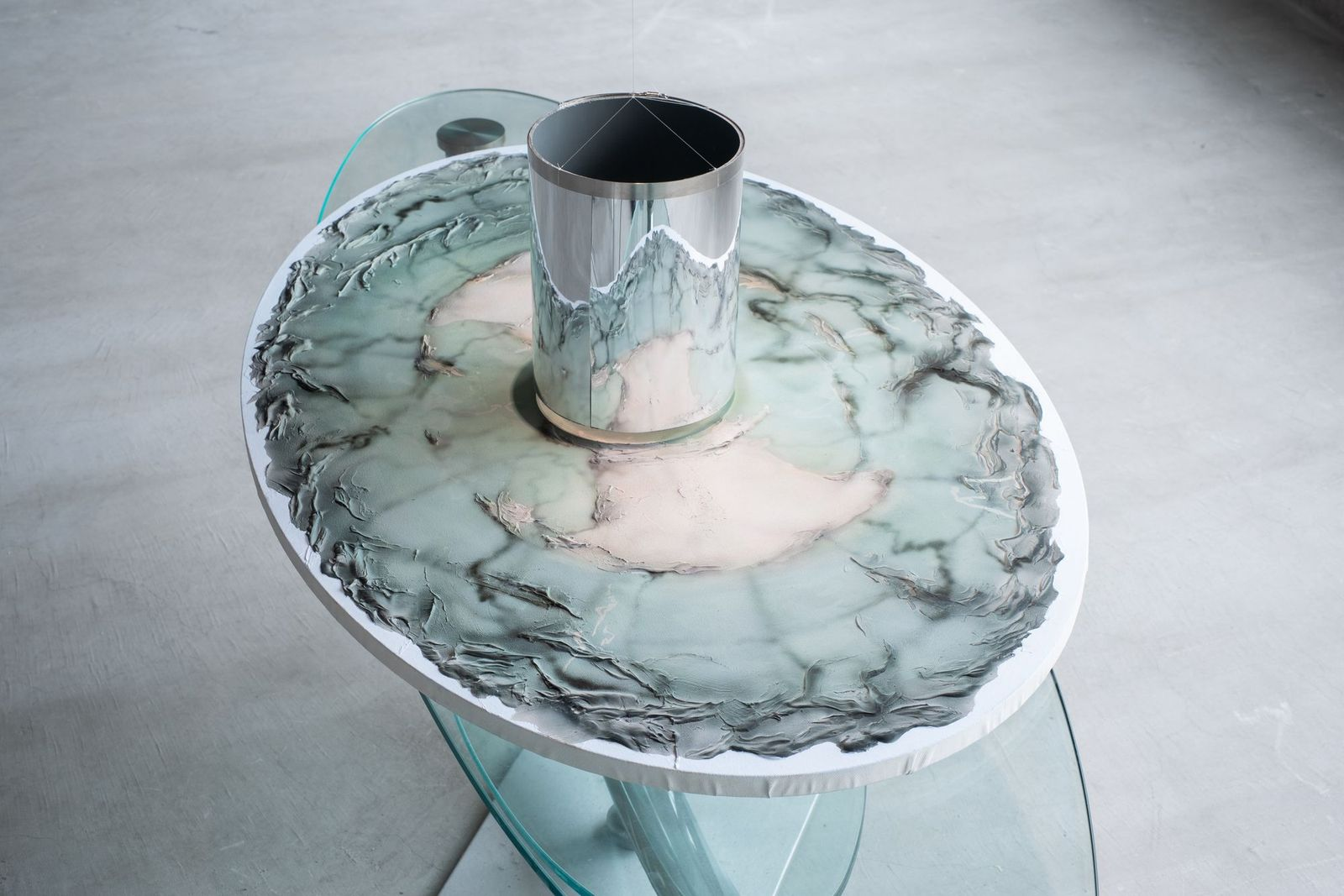
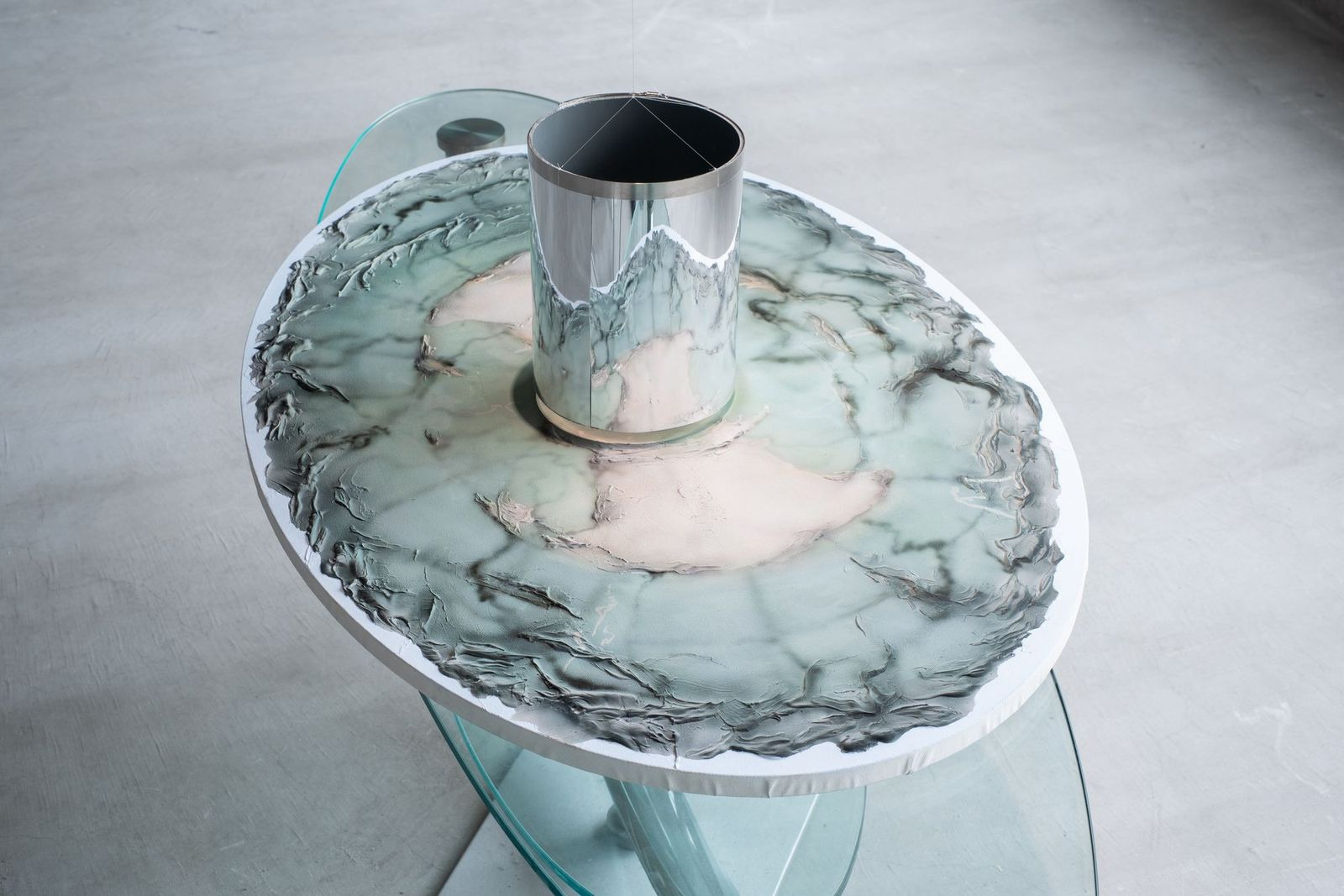
山縣:まず「界面奇観」は、鏡面でできた円筒を置くことで、風景画を立体で見せています。一般的にアナモルフォーシスという手法は、わざと歪ませた絵を描き、円筒の鏡面で正しい像を見せることが多いようです。私は、円筒に写った絵の中の凹凸(山の部分)が、こちらに向かって立ちはだかるような像に変化することに気づいて、それが風景の中にアイレベルで立つような視点だなと思いました。絵は平置きしているので、地表を俯瞰することと、アイレベルを行き来することができる。この図式的な行き来が、先にあげた荘園絵図の経験であり、GoogleMapのリアリティでもある。絵画の中で描き手の運動や視点といった身体像に触れることが重要だと考えています。
千葉:僕もこれには興味があって、調べたことがあります。日本では、江戸時代に刀の鞘を中心に置いて見たから鞘絵と呼ばれていたそう。海外にも同様の技法があるようです。
山縣:面白いですよね。私自身は、荘園絵図のような表現をイメージしています。「地へのイリュージョン2」は、Googleマップの景色を描いています。衛星地図をみていると、どこまで拡大しても地球はただの模様だと思えます。風景でも地図でもなく、すべては薄っぺらくて、スルスルした一枚の皮膜のようです。
──もともと地図が好きだったんですか?
山縣:いいえ、かつて旅行に行った場所を衛星地図のモードでで見ていたら迷子になって、でもその景色が凄くてたくさん見るようになりました。ちょっとその話をしたいと思います。
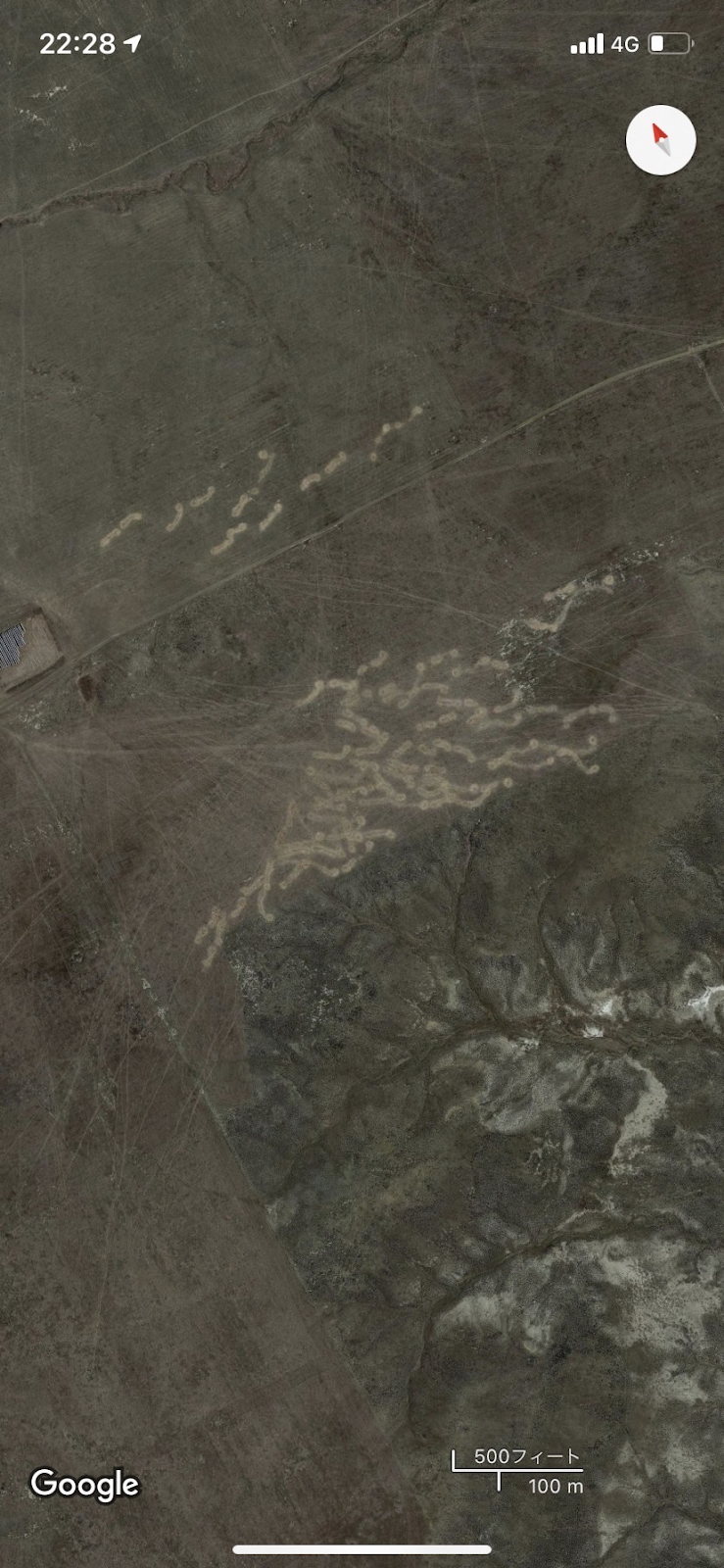
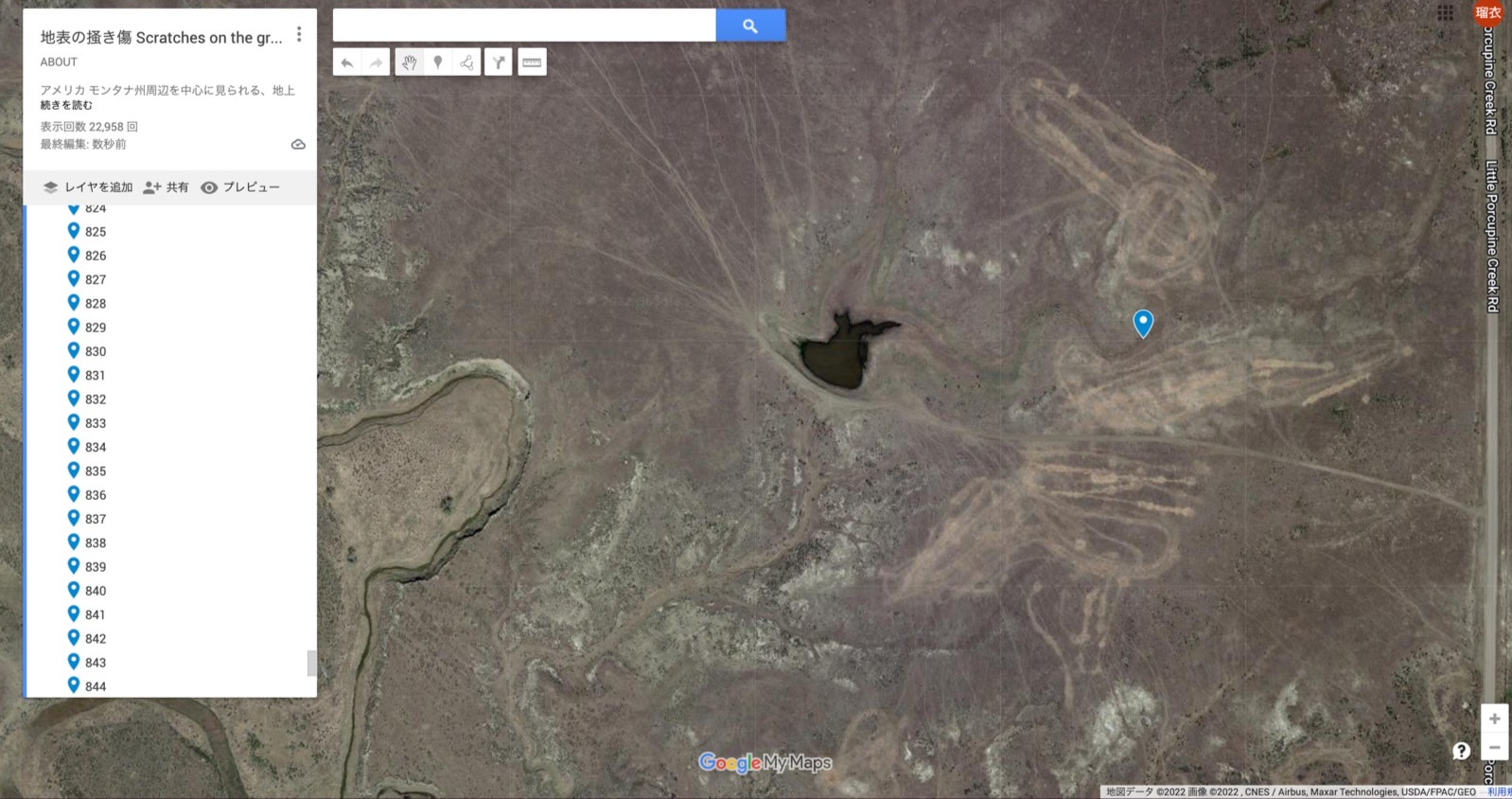
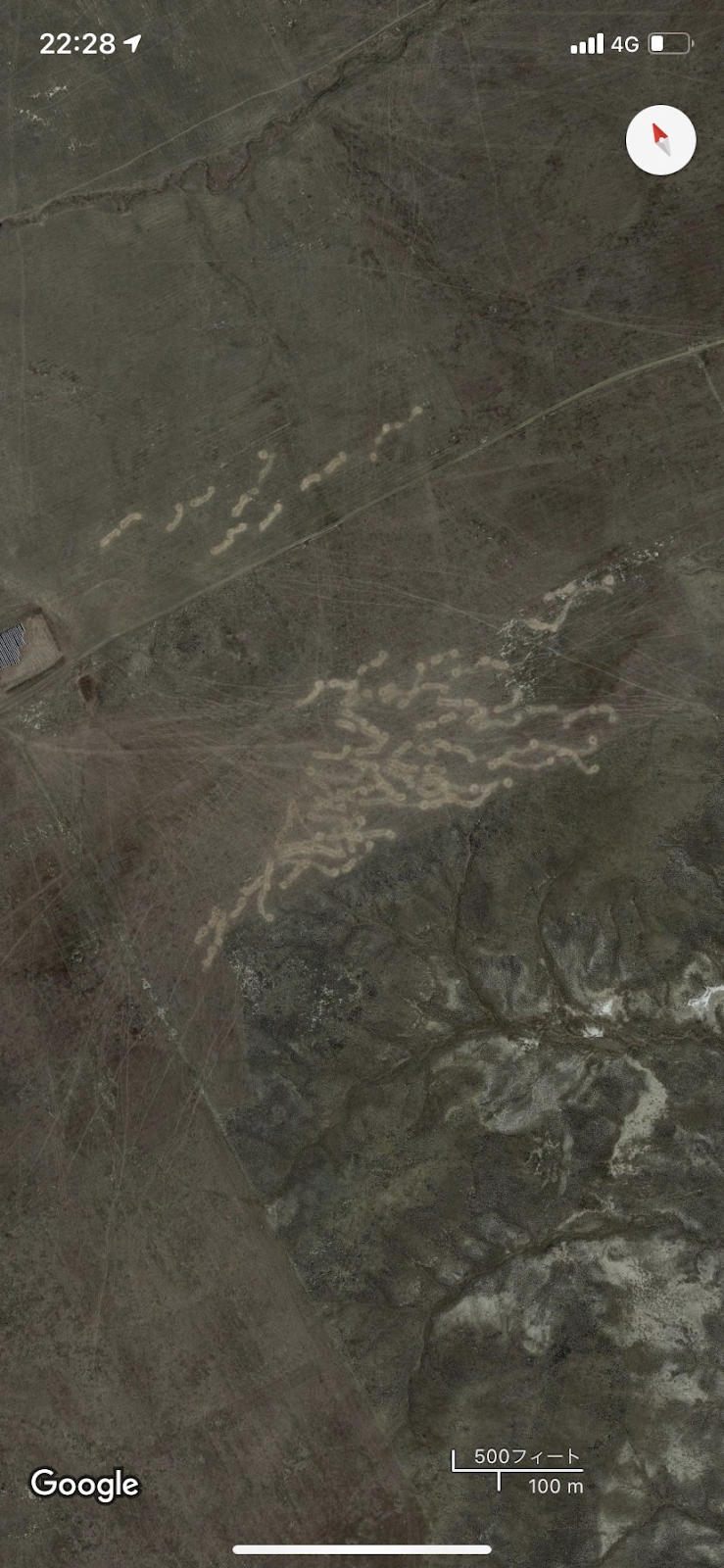
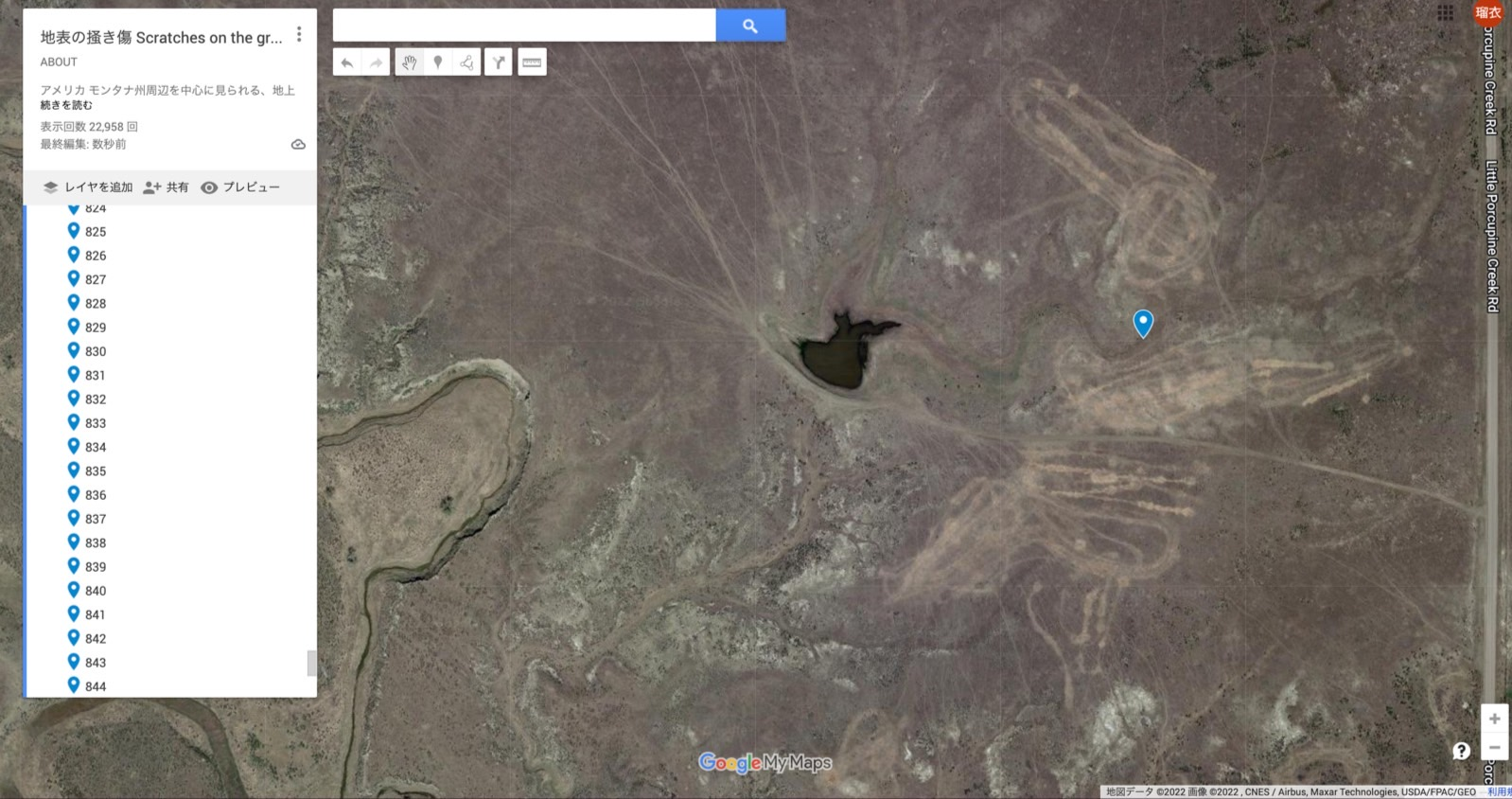
……Googleマップをあちこち探索していると、地表に変な模様のあるところが目に止まりました。地表を削ったような線が密集している模様で、自分の肌に起こるミミズ腫れによく似ていたんですね。ナスカのような地上絵を見つけてしまったのかと思いましたが、どうやら轍のようでした。この模様は何故かアメリカのモンタナ州にたくさん見られて、同州の地質局に問い合わせると「干し草のロールを載せた作業車が牛に餌をやるために走り、パラパラと落ちた干し草を牛が食べると、その跡としてこういう模様が残る」ということでした。たしかに、Googleマップの航空写真をぐんと拡大してやると、ゴマ粒のような点々が見えてきた……。
なにが言いたいかというと、これらはすべて家で調べたものですが、いわゆる現実にひけをとらない強度があったんです。一般的に、地図は実世界の模造物として捉えられますが、それ自体にひとつの経験があったように思います。謎の模様を探していくにあたって地図をしらみつぶしに見ていました。現実のスピードとは違うスピードで場所を見渡していくから、主観的な地形が自分の中で生まれる、謎の模様は数百メートルの規模があるけれど上空から一望することができる。
何よりこの過剰なほどリッチな、連綿と続く衛星写真が、模様によって突然、削るように断ち切られた経験がありました。これがきっかけで風景画を生み出せないかと思いました。
──Googleマップから描く風景画は、普通の風景画と違いますか?
山縣:ぜんぜん違います。いざ風景画を描こうとすると、まず横に線をひゅっと描く人が多いですよね。そんな線は自分の身体にはないんですが、遠近法を私は知ってしまっているからそうなるんです。それに対して、Googleマップの経験から風景を描くと、そもそも俯瞰図ですから、横線は要らなくなり、地表の観念は模様に純化されるような…。ヒト・シュタイエルが俯瞰という視覚形式について論じていてすごく刺激的でした。あらゆる事物の表面がマッピングされ得る状況の中にいて、私の肌も既に地図の一部です。上空から撮影された地図を見ている自分の背後上空にカメラがある。従来の風景画にも、少なくともそういった自己言及的な性格は見受けられますが、現代のこうしたGoogleMapの風景表現をふまえて一層アクチュアルなものにできればと思います。
[ライブペッティングと演技性──小寺創太]
──最後に、小寺さんお願いします。
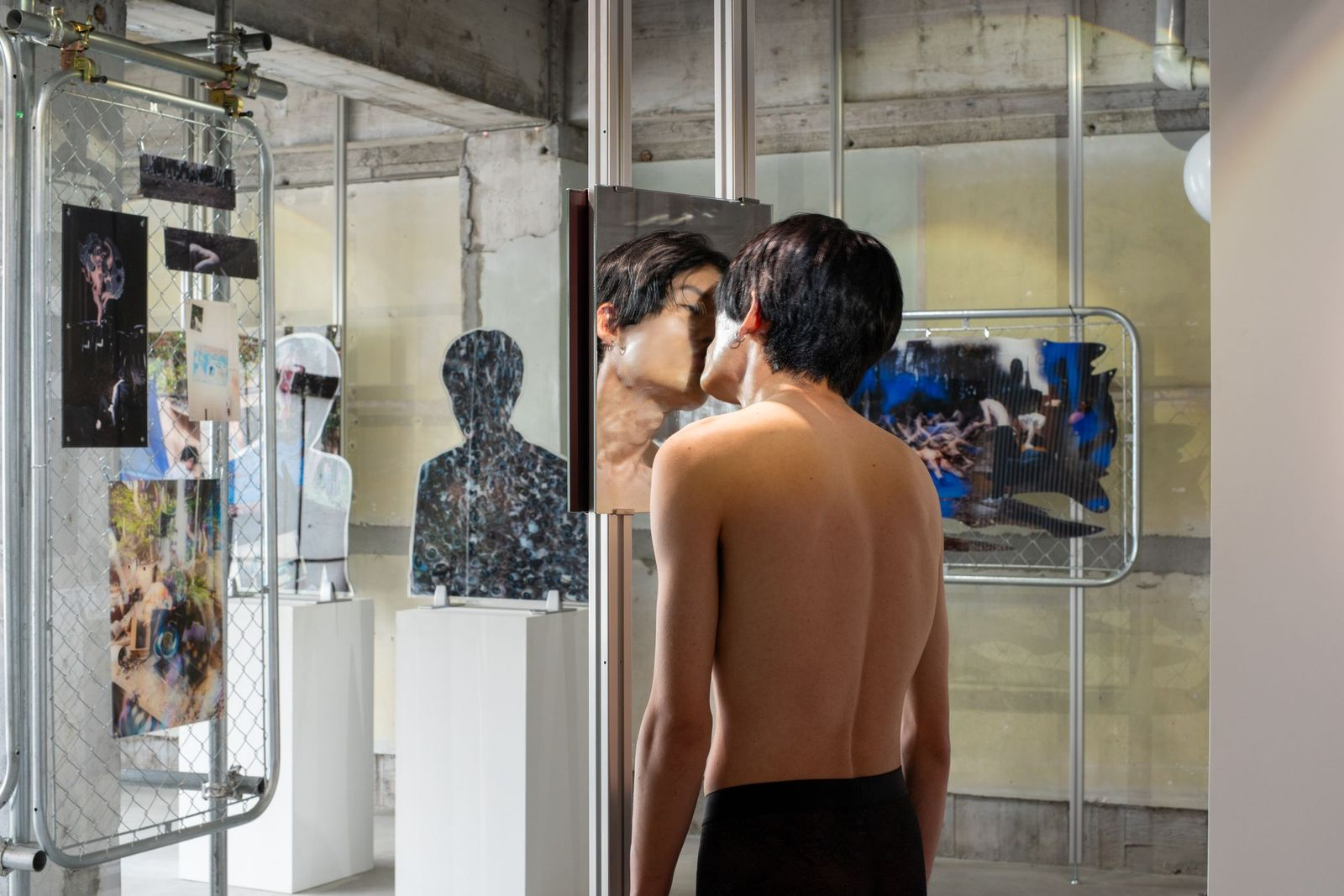
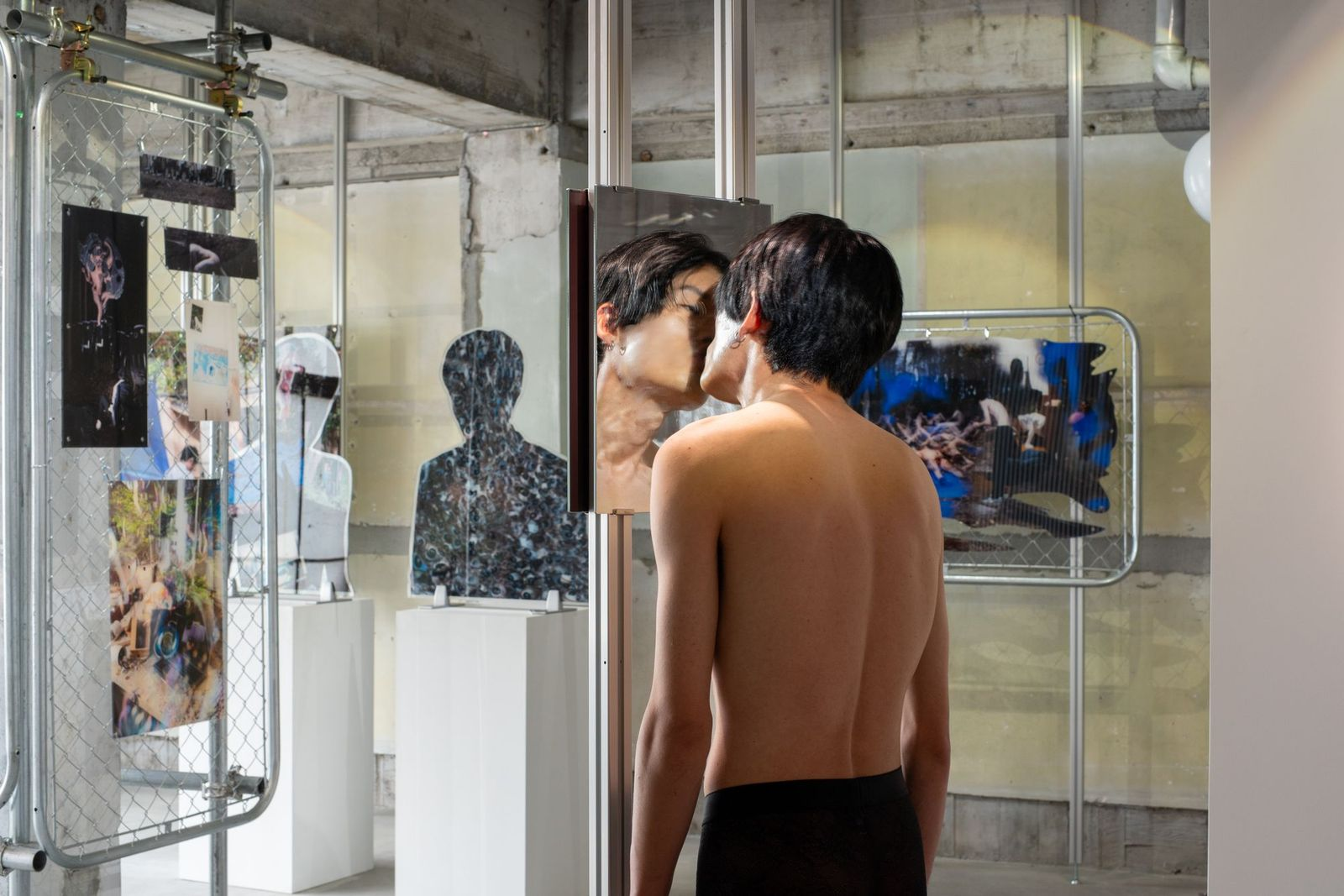
小寺:2021年末に、24時間ずっと身体をそこに置いて展示物になろうというill派の企画がありました。そのとき、俺は上半身裸で鏡にずっとキスをするというパフォーマンスをやったんです。これが面白かったので、今回もやってみようかなと。ライブペインティングとペッティングをかけて、ライブペッティングって呼んでいます。
──すると鏡にキスする行為は、パフォーマンスであるとともに、絵を描いていることでもあるんですか?
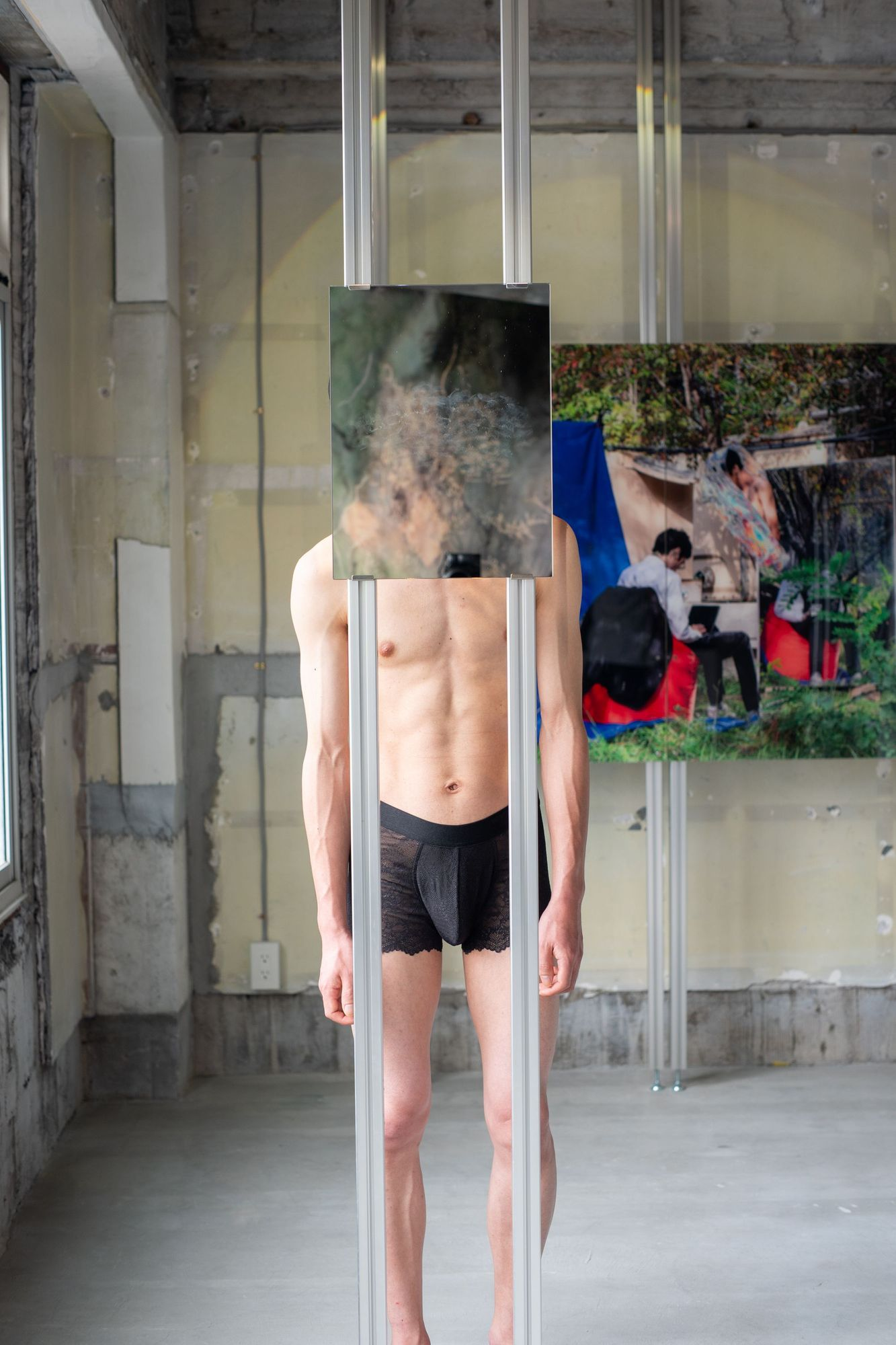
小寺:そうですね。でも、もともと意図していたわけではありません。最初は本当にただ唇を当てているだけだったんだけど、だんだんとベロチューのようなキスをするようになって。そうしたら、よだれが滴って、綺麗だなと思えてきた……まあ、汚いんですけどね。さらに6時間くらいすると、絵を描いているときの感覚になってきたんですよ。それからは絵画として平面を仕上げるようにキスをしていきました。少し椅子を使って、届かないところに唇を当てたり、下塗りのように全体によだれを垂らしたり。舌を出して粒をつけるような感じを出すとか。今回は2日で1枚くらいのペースで、鏡を仕上げていくようなイメージかなと思っています。
──こういう表現をするときは、普段の自分と違いますか?
小寺:陶酔した感じというか、自分大好きみたいなモーションがかかるというのはあります。もともと演劇をやっていたんですけど、それと比べるとここからが演技、ここからは素の自分といった明確な境界はないかもしれません。演劇であれば、鑑賞者はあらかじめ演じていることを了解のうえで観劇しますよね。それに対して、展示の場合は、作者自身の赤裸々な行為なのだと鑑賞者は実存的ロマン主義的に解釈する節がある。こういうインタビューも近いところがあると思いますけど。
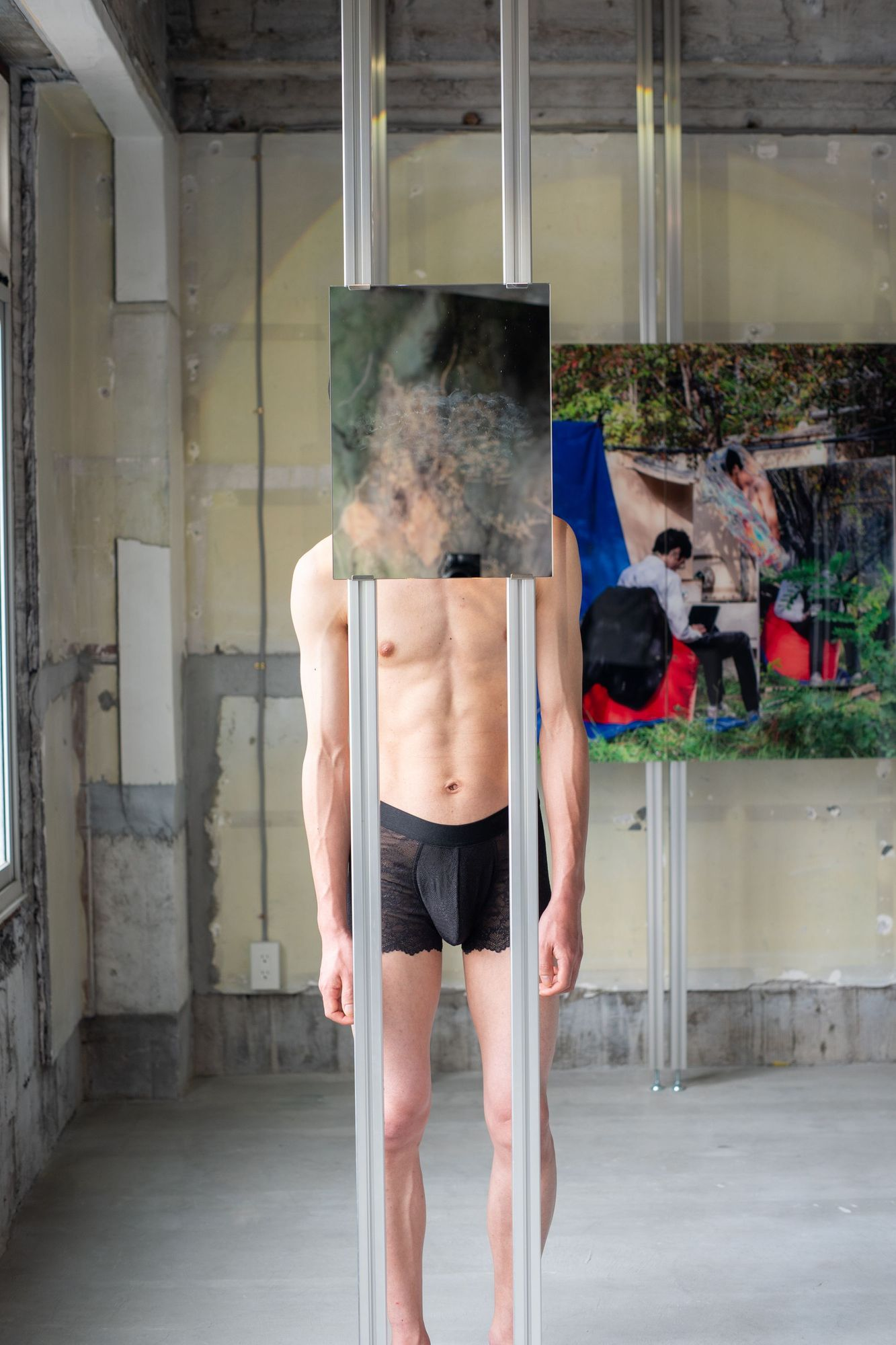
ただ、衣装を着ているか着ていないかで気分が変わるところはあります。前回は作業着のズボンに上裸でしたが、今回はワコールという下着メーカーにセクシーなレースのボクサーパンツがあったので、それを穿くつもりです。髪も少し濡らして、ちょっとエロい感じに。それから、バスローブを買いました。絵を描いたり、トイレとかで鏡を見たりするときって、ちょっと後ろに下がって全体を見ますよね。そういう感じで、キスをせずに経過を確認するときは、バスローブを着ようかなと。
千葉:話を聞いていて、小寺君は本当に幸運な作家だなと改めて思いました。
小寺:どういうことですか(笑)
千葉:作家性というか、自身のキャラクターと作品のコンセプトがガッチリ噛み合ってしまったから。そういうことって、作家人生のなかで一度も経験しないアーティストもいると思う。先日まで開催していた個展「調教都市」を見たときにも感じたことなんだけど。
[還元されない身体]
──作品紹介ありがとうございました。最後に、それぞれの作品や展示全体についてコメントをいただけたらと思います。
小寺:すごくイメージの強いメンバーが集まったと思います、ギロチンは良くも悪くも趣味がいいな。個人的には、いわゆるグループ展というか、自分が主導するものでもなく、ただ作品だけ出すものでもない展示は久々なので、その点でも新鮮です。
千葉:最初に自分より若い作家が集まっているという話をしましたが、作品に現れるのも若い身体なんですよね。僕は各国の民主化運動とか、今回の桃とか、なにか特定のモチーフがあることが多くて、それを身体にまとったり、覆ったり、コーティングしている。だから直接肌を見せることはないのに対して、小寺くんやBALL GAGくんは自分が出てくるし、山縣さんはミミズ腫れの話がある。そこには新しいアングラ的な身体イメージがあるかもしれません。
山縣:私は今回のメンバーそれぞれの自己を独特な方法で物、対象化している手法になにかいびつな..タナトスめいたものを感じています…。物を置き去りにした政治的、社会的な意味での「声」を集めるキュレーションはここにはないので、彼らの作品の言語体系を私もよく見つめたいです。
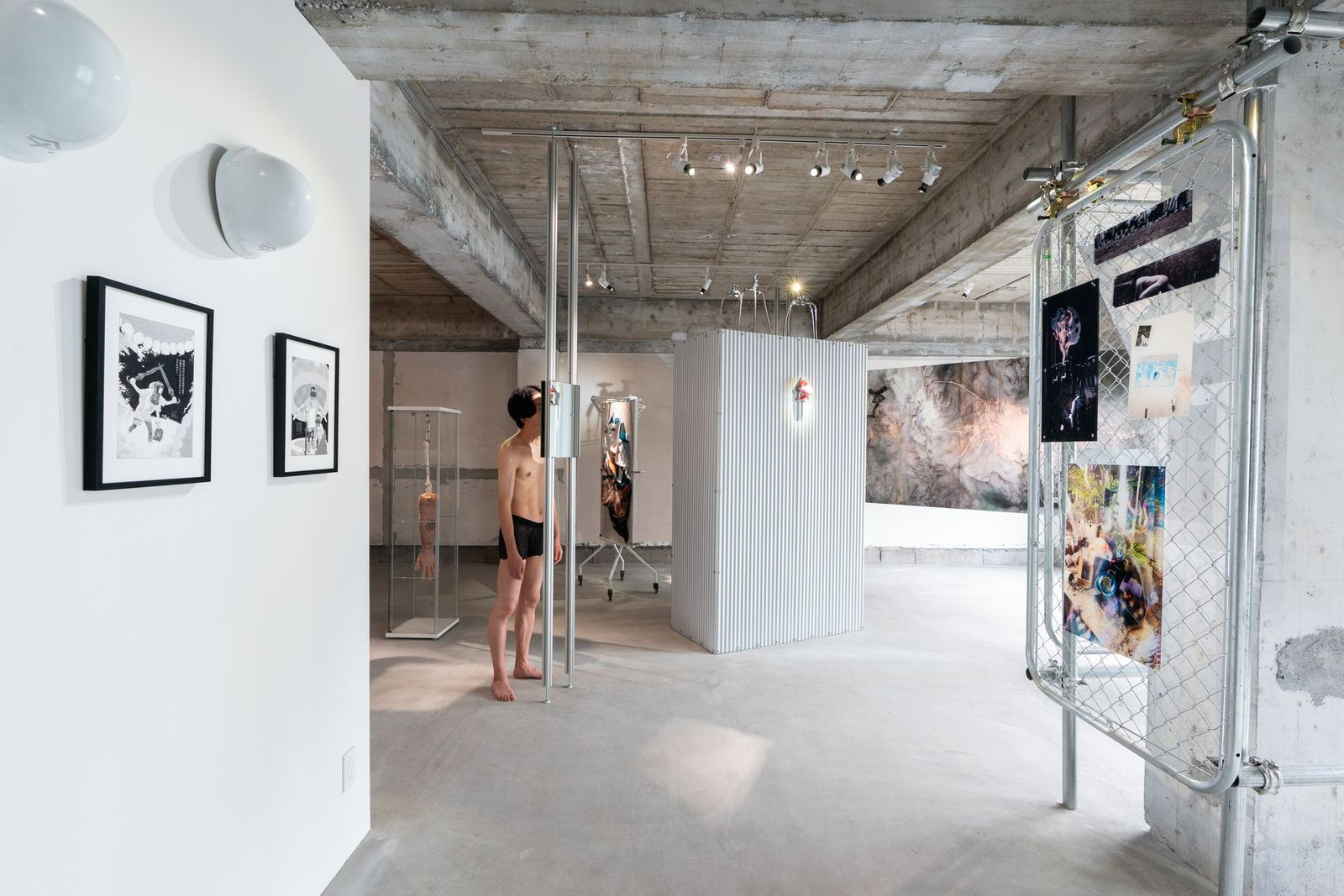
BG:東北から東京に来てあちこちの展示に行ってみました。そこで感じたのは、展示や作品がどこに位置づけられているかという俯瞰性と、その座標に留まろうとする位置エネルギーのような力を内包したものが自分は好きだということでした。そして、この展示もそうです。直接的には、山縣さんの作品が絵画としての力と、それが絵画のなかでどの場所にあるかを示そうとしているように思いますが、展示全体を通じて、自分たちはここにいる、ここにある、ということを感じさせるものになったと思います。
<!--/JA--> <!--EN-->
"Kaimentai" is an exhibition by Sota Kodera, Daijiro Chiba, Rui Yamagata, and BALL GAG. The four artists gathered here each sit at the boundaries between various media, yet without closing themselves within any one of them, nor being reduced to any single category. What, then, are the concepts and processes behind works that continue to sustain such interfaces, and what kinds of bodily sensations do they produce? We spoke with them openly and at length.
Text: Seshimo Shota All Photo: Naoki Takehisa
Title: Kaimentai (The Interface Body) Artist: Sota Kodera, Daijiro Chiba, Rui Yamagata, BALL GAG Term: May 21 (Sat) – June 5 (Sun), 2022 Opening reception: May 20 (Fri), 18:00–21:00 at CON_
── First, let's begin with introductions. Could you briefly describe your practice and the works you're showing this time?
Sota Kodera (hereafter, Kodera): I'm Sota Kodera of the "post ill-ha" school. I originally went by "ill-ha" (the "being-there" faction), making works in which I myself was "there" in the exhibition. Recently though, I've come to appreciate works that don't involve my own body, so now I call myself "post ill-ha." In this exhibition I'm revisiting an earlier work: I continuously kiss a mirror and produce a painting from the marks left behind. Since it's ultimately a painting, it still fits the "post ill-ha" label.
Rui Yamagata (hereafter, Yamagata): I'm Rui Yamagata, and I primarily make paintings. I've long been interested in the relationship between painting and the body of the painter—especially the skin. Recently I've also been drawn to things like medieval Japanese estate maps (shōen-ezu) and rice-field maps (kaiden-zu), which intermingle eye-level landscape with bird's-eye views, as well as satellite imagery on Google Maps. In this exhibition, I'm attempting landscape depictions in which the painter is embedded as skin, drawing from the existence of such maps.
Daijiro Chiba (hereafter, Chiba): I'm Daijiro Chiba, a Hassuist. Hassuism advances the doctrine of "water repellence"—roughly, it's a philosophy and way of life that values controlling or repelling water. In developing this thought, we refer to talking like this, or exhibiting works, as "coating." This time I'm doing coatings with a large apparatus and a manga, using the fruit "peach" as a motif.
BALL GAG (hereafter, BG): I'm BALL GAG. I make work while thinking about the internet, smartphones, and various media. I'm especially interested in how humans react to evolving media—whether through adaptation, worship, or other actions. In the work I'm currently making, I use Wikipedia as a motif, and consider how history is edited through its accumulating edit-history data, stacked like parchment palimpsests.
[Around the Interface]
BG: … Also, this is my first exhibition in a year, and it's the first time I've made work while having these kinds of conversations. Back at Kyushu University of Design, there were only one or two people I could talk about art with. So this is really enjoyable. The artists gathered for this show are people whose work I'd admired for a long time online, so I'm a little overwhelmed…
Chiba: I think of everyone as classmates on the scale of a hundred years, so I don't really feel like a senior. But on a scale of a few years, everyone here is younger than me—that might be a first. When we were exchanging exhibition ideas over LINE, and Instagram images kept pouring in, I really felt our brains were wired differently.
Kodera: No no, I couldn't keep up either (laughs).
── As with the previous show "Ultra-thin inframince," did you exchange references via chat during preparation?
GILLOCHINDOX☆GILLOCHINDAE (hereafter, Gillotine): I'm Gillotine, the director. This time too we set up LINE and Instagram groups. On Instagram, it happened to coincide with the release of the film "TITANE," so some pretty intense URLs were flying around (laughs).
BG: I sent some body-modification stuff that might've been a bit much, and regretted it later… In those exchanges, I found it fascinating that Kodera was well-versed in Japanoise.
Chiba: The book exchange was memorable too. Books come in different species. I mostly collect the kind you find in used bookshops, so my shelves look reddish-brown. The other three bring in a lot of new books—the quality of input is different. Naturally the output differs too.
BG: Chiba shared shamanism-related books like Carmen Blacker's "The Catalpa Bow: A Study of Shamanistic Practices in Japan" and Aby Warburg's "A Lecture on Serpent Ritual."
Kodera: I was interested in the erotic books Chiba brought.
Yamagata: I was drawn to the ghost theory book Kodera shared.
Kodera: That was Kiyoaki Oshima's "Contemporary Ghost Theory: Yōkai, Ghosts, and Earthbound Spirits."
Gillotine: BALL GAG brought a lot of zines, didn't you?
BG: Yes. I was also drawn to the body- and feminism-related things Yamagata shared.
Yamagata: That was Catherine Malabou's "Pleasure Erased." When the title "Kaimentai" first came up, I thought the sound would evoke male genitalia, so I offered this book—which discusses the female "spongy body" (kaimentai in Japanese) and the clitoris.
[Body and Interface]
Yamagata: In the run-up to the show we also had Zoom meetings—well, more like drinking parties. When I joined, everyone was deep into obscure manga talk, and I'd just eat while thinking, "I don't understand any of this" (laughs).
Just before the announcement, Gillotine told me the lineup had been chosen with a "special-ability users" vibe, which made me laugh.
Gillotine: Like the Phantom Troupe from Hunter × Hunter—I wanted to gather artists who evoke the urban violence and dark side of the city. I've always been drawn to the violent aspects of big cities: the height of skyscrapers, the speed of trains.
── When I first saw each of your works, I did sense that violence and darkness—an underground atmosphere.
BG: "Underground" as an image, I think, is something that objectifies the bodies of others. My approach is the opposite. Rather than using others' bodies to express something, I feel like I consume my own body—offer it as a sacrifice. I start from making myself bleed first, objectifying and anonymizing my own body and subjectivity.
I feel the others here share this: none of you treat the body emotionally. You treat it as a medium—as an "interface."
Gillotine: Yes. Listening to you all, I came to feel that it was crucial how each person—Kodera with ill-ha / post ill-ha, BG, Yamagata, Chiba—engages with their own body in their expression.
── And from there the concept emerged?
Gillotine: Yes. I'll let BG explain in detail, but BALL GAG has a photographic series called "Kaimen" (Interface) that's included here. Adding a bodily nuance to that, we arrived at the exhibition title "Kaimentai" (The Interface Body).
Kodera: Since I was already planning to do the mirror-kissing piece again, it fit perfectly. A mirror is literally an interface.
Yamagata: Same for me. I'm interested in the body as it paints while facing the world, so it felt very close—I was glad.
[The Narrow Internet and Edit Wars ── BALL GAG]
── Let's start with BALL GAG's photo work, which came up earlier.
BG: Yes. The photo series "Kaimen" (Interface) was made while reflecting on my relationship with the internet since COVID. Shut in my room, getting information about the pandemic and social conditions through social media, I started thinking about place, community, and the other.
The first figure is a fully nude human—someone whose face is invisible, like an account on social media. The next is a clothed figure, belonging to no community. As they move between places, the clothing gradually comes undone until the figure is nude again.
As for the settings, the nude and clothed figures correspond to inside and outside—a private room versus a forest. The forest is a metaphor for cyberspace: an outside that's also enclosed. There is no subject there, only objectified plants.
── So it deals with social themes.
BG: The theme is the small nationalisms that arise between individuals on social media. Who you encounter there may seem accidental, but it's arbitrary—determined by the platform. Accounts assembled through such arbitrary choices form archipelagos. They belong to narrow communities, project subjectivity onto objects, and construct events as truth. It reflects the political worldview of young people, and an image of a localized, closed society.
── Interesting. Next, what is this text-heavy work?
BG: It's based on palimpsests—parchment manuscripts on which previous writing was erased and overwritten. Historically significant things have been recovered from palimpsests, like previously incomplete biblical texts and Archimedes' principles. When I learned about palimpsests, I thought of Wikipedia, and that led to this work.
The text on the whiteboard is Wikipedia edit history—specifically about Japan's colonial policies in Asia during World War II. The edit history preserves a running battle between people who argue the colonial policies contributed to Asia's liberation and that Japan was the leader of the region, and those who argue the colonization cannot be justified. It's like a reply-war. I make the work by writing and erasing text on the whiteboard repeatedly.
Next to it stands a figure writing and erasing the text. It's made from minimal materials bought at IKEA and Amazon, standing self-supported like a stone monument. Through making this, I'm thinking about how history is edited in our time and where those edits persist. It's the palimpsest of the era in which records survive as data.
Yamagata: The objecthood is fascinating. For the Wikipedia piece, you don't use the whiteboard directly but insert another sheet between; for "Kaimen," you use acrylic frames for translucency.
BG: I want to erase my own scent. When I paint, a macho, masculine side of me comes out and I find that unpleasant. For "Kaimen," I also chose acrylic because of its connection to the world of smartphones. But the main reason is wanting to de-scent myself as much as possible, to create distance. That might be why I keep choosing photography, acrylic, and thin media.
["Unsinkable Peach" Coating ── Daijiro Chiba]
── Next, could Chiba introduce his work?
Chiba: This time the coating is "peach." Using the motif of an "unsinkable peach," I made a shower room and a manga-like image.
The shower room is, so to speak, a confession booth. That word has Christian overtones, so to avoid that, let's call it a reflection room. The room's interior is hidden from view, and a faucet extends from inside up near the ceiling, circulating a viscous pink liquid. Like a peach being split open to give birth to a human, this is a device for being born again and again, while still alive.
The manga supplements the installation with images and scenes. There's a figure cutting open a peach themselves, six-limbed twins emerging like water striders, then being bitten and chewed up by something tooth-shaped—one of the twins dies.
── Have you long used this kind of apparatus-and-manga coating?
Chiba: Yes, more or less. But it's not fixed; the coating methods emerge as I actually work on them.
For installations, I recently made one like a big waterwheel. The boards were originally white, but when I realized that wasn't conveying the idea, I changed them to red and it became an image of an inside-out oral cavity—a gear of death that sweeps everything up. There was a stage around the waterwheel where, each time I shouted lines based on Hassuist doctrine, I'd repeat the motion of crawling, then creeping, then toddling, then standing upright. I didn't think of this movement on day one; I just crawled the whole time and ended up ragged from head to toe.
It's similar with manga. I didn't draw manga before. Like a monk explaining Buddhist cosmology in front of a nirvana painting, I'd explain the work myself and call it coating. But since I'm not always at the venue, at some point I decided to use manga. Manga combines text and image in a format everyone's familiar with—it can stand in as a statement and also be a work. I'd wanted to be a manga artist anyway, so I thought it was a good coating for exhibitions.
BG: You have various names: the duo "Kounan," your stance as Hassuist, etc. It gives you a mysterious aura. Your work, too, seems to hold both precariousness and energy at once.
Chiba: Thank you. If I ask myself why, it may be because I value intuition and tend to skip the process to arrive at answers. With the "twins" in this work, I intuited the importance of clashing pairs and the emergence of a third thing. With "Kounan," since as a Japanese-painting major I usually only needed an art-supply store, when I thought I'd feel more creative at a hardware store, there happened to be a "Kohnan" (Japanese hardware chain) nearby. But in retrospect, that name expresses a way of being. Conversely, all the making, output, and coating is, for me, a process of verifying and checking the naming.
[The Body That Looks at Google Maps, the Body That Paints ── Rui Yamagata]
── Next, Yamagata.
Yamagata: "Kaimen Kikan" (Interface Spectacle) places a mirrored cylinder on a landscape painting, showing it three-dimensionally. Conventionally, anamorphosis involves drawing a deliberately distorted image that a cylindrical mirror makes legible. I noticed that the unevenness in the reflected painting (the mountainous parts) transforms into an image of something looming toward you, and I thought that felt like standing at eye level within the landscape. Because the painting is laid flat, the viewer can move between bird's-eye view and eye-level view. This diagrammatic back-and-forth is the experience of estate maps and the reality of Google Maps. I believe it's important that painting touches the painter's bodily movement and viewpoint.
Chiba: I was also interested in this and looked into it. In Japan, during the Edo period, it was called saya-e (scabbard painting), because people placed a sword scabbard at the center to view it. Similar techniques exist abroad.
Yamagata: Interesting. For my part, I imagine something like estate maps. "Illusion toward the Earth 2" depicts a Google Maps landscape. When you look at satellite maps, no matter how much you zoom in, the earth just seems like a pattern. It's neither a landscape nor a map—everything is flat, a single smooth skin-like membrane.
── Did you originally like maps?
Yamagata: No. I once got lost looking at a travel destination in satellite mode, but the view was so striking that I started looking at them a lot. Let me tell the story.
… While exploring Google Maps, my eye caught on strange patterns on the earth's surface—densely clustered lines that looked like the surface had been scraped, very similar to the hives on my own skin. I thought I'd found something like the Nazca Lines, but they turned out to be tire tracks. For some reason they were very common in Montana, USA, and when I asked the state geological survey, they told me: "Trucks carrying hay rolls drive along to feed the cattle; the hay falls bit by bit, and when the cattle eat it, the pattern is left as a trace." Sure enough, when I zoomed in on Google Maps aerial photos, I could see sesame-seed-like dots…
What I want to say is: all of this I researched from home, but it had an intensity that wasn't inferior to reality itself. Maps are generally thought of as imitations of the real world, but I felt they contain an experience of their own. While searching for the mysterious patterns, I scoured maps thoroughly. Looking at places at a speed different from reality generates a subjective topography in me, and mysterious patterns hundreds of meters in scale can be surveyed in one glance from above.
Above all, I had the experience of this excessively rich, endlessly unfolding satellite imagery being suddenly interrupted—sliced—by a pattern. That's what led me to think I might make landscape paintings from it.
── Are landscape paintings drawn from Google Maps different from ordinary ones?
Yamagata: Completely different. When people try to paint a landscape, many start by quickly drawing a horizontal line. That line doesn't exist in my body, but because I know perspective, I end up doing it. By contrast, when you paint from the experience of Google Maps, since it's originally a bird's-eye view, the horizontal line becomes unnecessary, and the concept of the earth's surface is purified into pattern. Hito Steyerl's discussion of the bird's-eye view as a visual form was very stimulating. In a situation where any surface can be mapped, my skin, too, is already part of a map. A camera is positioned in the sky behind me as I look at the map photographed from above. Traditional landscape painting has at least this kind of self-referential character, but I hope to make it more current by incorporating the landscape representation of today's Google Maps.
[Live Petting and Performativity ── Sota Kodera]
── Finally, Kodera.
Kodera: At the end of 2021, there was an ill-ha project where you'd place your body in the space for 24 hours and become part of the exhibition. I did a performance where, topless, I continuously kissed a mirror. It was interesting, so I thought I'd try it again. I call it "live petting"—playing on "live painting" and "petting."
── So the act of kissing the mirror is both a performance and the making of a painting?
Kodera: Yes. But I didn't intend it that way from the start. Initially I was really just pressing my lips. Gradually I started doing more tongue-heavy kisses. Then the saliva started dripping and I found it beautiful… well, disgusting, but beautiful. After about six hours, I started feeling like I was painting. After that, I was kissing in order to finish the surface as a painting. I'd use a chair to reach high spots, let saliva drip all over like a ground coat, stick out my tongue to apply grain-like droplets. This time I'm thinking I'll finish one mirror roughly every two days.
── Is your state different from your everyday self when making this kind of expression?
Kodera: There's a sense of intoxication—a self-love kind of mode sets in. I used to do theater, and compared to that, the boundary between "acting from here" and "my bare self from here" isn't clear. With theater, audiences watch knowing in advance that performance is happening. In exhibitions, viewers tend to interpret the artist's acts existentially, romantically—as the artist's raw, unfiltered behavior. Interviews are similar, I think.
That said, whether I'm in costume or not changes my mood. Last time I wore work-pants and no shirt, but this time Wacole (a Japanese underwear maker) had some sexy lace boxer briefs, so I'm going to wear those. I'll wet my hair slightly, for a bit of an erotic look. And I bought a bathrobe. When painting, or checking yourself in the bathroom mirror, you step back a little to see the whole, right? When I'm checking progress without kissing, I'll wear the bathrobe.
Chiba: Listening to this, I'm reminded again how lucky an artist Kodera is.
Kodera: What do you mean? (laughs)
Chiba: Your artistic persona and the concept of your work lock together perfectly. Some artists never experience that even once in their career. I felt it at your recent solo show "Chōkyō Toshi" too.
[The Irreducible Body]
── Thank you for introducing your works. Finally, could each of you share a comment on the overall exhibition?
Kodera: Artists with very strong imagery have gathered, and Gillotine has good taste—for better or worse. Personally, this kind of group show, where I'm neither leading nor merely submitting a work, is rare for me, so that aspect feels fresh.
Chiba: I said earlier that younger artists had gathered, and it's young bodies that appear in the works. I often deal with specific motifs—democracy movements in various countries, or peaches this time—and I drape, cover, or "coat" them over the body. So I don't show skin directly. In contrast, Kodera and BG themselves appear; Yamagata talks about hives. There may be a new underground body-imagery here.
Yamagata: I sense something warped—something Thanatos-like—in how each of the members turns themselves into object in their own way… This isn't a curation that gathers political, social "voices" by leaving objects behind, so I want to look closely at the linguistic system of everyone's work.
BG: Coming to Tokyo from the Tohoku region, I've visited many exhibitions. What I realized is that I like works and exhibitions that have an overhead sense of where they're situated, containing a kind of potential energy that tries to remain in that coordinate. This exhibition is one of those. Most directly, Yamagata's work seems to demonstrate the force of painting and its place within painting. But through the exhibition as a whole, I think it's been made into something that makes us feel: we are here, these works are here.
<!--/EN-->
<!--JA-->
小寺創太、千葉大二郎、山縣瑠衣、BALL GAGによる展示「界面体」。集まった4人の作家は、さまざまなメディアの境界にありながら、そのどれかに閉じることも、還元されることもない。そうして界面を維持し続ける作品のコンセプトや制作過程、また、そこで得られた身体感覚はどのようなものだろうか。ざっくばらんに語ってもらった。
Text: Seshimo Shota All Photo: Naoki Takehisa
Title: 界面体 Artist: 小寺創太, 千葉大二郎, 山縣瑠衣, BALL GAG
Term: 2022.5.21(SAT) - 6.5(SUN)
Opening reception: 5.20(FRI) 18:00-21:00 at CON_
──まず、それぞれの自己紹介から始めたいと思います。自身の制作のスタイルや、今回展示する作品について簡単に語っていただけますか。
小寺創太(以下、小寺):post ill 派の小寺創太です。もともとはill 派(いる派)と名乗って、自分が展示のなかに「いる」作品をつくっていました。ただ、最近は自身の身体が介在しない作品もいいなと思うようになったので、post ill 派だなと。今回の展示では、以前やった鏡にずっとキスをし、その跡で絵画を制作する作品をふたたび制作します。あくまで絵画作品なので、これもpost ill 派っていう感じです。
山縣瑠衣(以下、山縣):絵画を中心に制作しています、山縣瑠衣です。絵画と、描き手の身体、特に皮膚との関係にずっと関心があります。また最近では、荘園絵図や開田図のような、アイレベルの風景と俯瞰図とが織り混ざったものや、Google Mapで見られる衛星写真に関心をもっています。この展示では、そうした地図の存在から、描き手が皮膚として埋め込まれた風景描写を試みます。
千葉大二郎(以下、千葉):Hassuistの千葉大二郎です。Hassuistは、撥水教という理念を掲げています。大雑把に言うと、水を制御したり、忌避したりすることを良しと考える思想であり生活態度です。思想を展開するうえで、こうやって話したり、作品を展示したりすることを「コーティング」と呼びます。今回は果実の「桃」をモチーフに、大きい装置と漫画によるコーティングをしています。
BALL GAG(以下、BG):BALL GAGです。インターネットやスマートフォン、さまざまなメディアについて考えながら作品を制作しています。とりわけ、進化していくメディアに対して、人間は適応したり、あるいは信奉したり、どういうアクションを起こすのかに興味があって。いま制作している作品では、ウィキペディアをモチーフにして、羊皮紙のように積み重なっていく編集履歴のデータから、歴史がどのように編集されてゆくかを考えています。
[界面の周辺から]
BG:……あと、僕は展示自体が1年ぶりで、しかも、こうやって話しながら展示をつくっていくのって初めてなんですよ。芸工大時代は、アートの話ができるのって1人か2人だったし。だから、とても楽しいです。この展示に集められたアーティストは、もともとインターネットで見ていてすごいと思っていた方々で、恐縮はしますけど……。
千葉:僕は百年単位で同級生だと思ってるんで、先輩ってこともないけどね。まあ、数年単位でみるとみんな年下で、それは初めてかもしれないな。実際、展示のことをLINEでやりとりしていて、おすすめのInstagramの画像がドドドドって送られてくる感じは、脳の出来が違うなと思いましたね。
小寺:いやいや、俺もついていけなかったですよ(笑)。
──前回の展示「極薄inframince」と同じように、制作にあたってチャットなどでレファレンスを出し合ったんですか?
GILLOCHINDOX☆GILLOCHINDAE(以下、ギロチン):あ、ディレクターのギロチンです。今回もLINEとInstagramのグループをつくっています。Instagramでは、ちょうど映画『TITANE/チタン』が公開されたタイミングだったから、エグいURLも飛び交ってて(笑)。
BG:身体改造系のものとか、ちょっとやりすぎなものを送ってしまって、あとで反省しました……。そういったやりとりだと、小寺さんがジャパノイズに詳しくて、面白かったですね。
千葉:あと、本を紹介し合ったのも印象に残っているかな。本にもいろいろな種族がありますよね。僕はいつも古本屋で手に入るタイプの本を集めているから、本棚は赤茶色い感じになる。ほかの3人は新品が多くて、インプットの質が違うなと。すると、当然アウトプットも違ってくる。
BG:千葉さんからはシャーマニズム関連で、カーメン・ブラッカー『あずさ弓──日本におけるシャーマン的行為』とか、アビ・ヴァールブルク『蛇儀礼』とか。
小寺:俺は千葉さんが持ってきていたエロ本が気になった。
山縣:私は小寺さんのあげていた、幽霊論が気になりました。
小寺:大島清昭『現代幽霊論──妖怪・幽霊・地縛霊』ですね。
ギロチン:BALL GAGはZINEをいろいろ持ってきていたよね。
BG:そうですね。ほかに興味を惹かれたのは、山縣さんがあげていた身体、フェミニズム関連のものです。
山縣:カトリーヌ・マラブー『抹消された快楽』ですね。「界面体」というタイトルを浮かべたとき、音的に、まず男性器が想起されるだろうと思って、女性の海綿体について、クリトリスについて論じた同書を挙げました。
[身体と界面]
山縣:展覧会までの経緯として、Zoomで打ち合わせというか、飲み会もやりましたよね。入ったときにみんなマニアックな漫画の話をしていて、わからない…とか思いながらご飯食べてました(笑)。
そういえば告知直前の時期に、ギロチンから、今回の展示は能力者イメージでメンバーを集めていったんだって聞いて笑いました。
ギロチン:幻影旅団みたいな感じで、都市の暴力性や黒い部分を感じさせるアーティストが集まるイメージだったんですよ。大都市にあるビルの高さや電車の速さみたいな、都市がもつ暴力的な要素が好きで。
──それぞれの作品を最初に見せていただいたときは、そうした暴力性や黒さから、アングラ的な雰囲気を感じました。
BG:アングラって、あくまでイメージですけど、他者の肉体を物化するものだと思うんですよ。自分はその逆なんです。他者の肉体をもちいて表現するのではなく、自分の肉体を消費するというか、生贄のように捧げて制作している感じがする。まずは自分が血を流すところから始めるというか、自身の身体や主体性みたいなものを物化させ、アノニマス化させるんです。
ほかのみなさんも、身体を情緒的に扱っていないところが共通しているように感じます。あくまで媒体というか「界面」として扱っているような。
ギロチン:うんうん。話を聞くなかで、小寺さんのill派 - ポストill派はもちろん、BALL GAGも、山縣さんも、千葉さんもそれぞれが自分の身体にかかわる表現をやっていることが重要に感じられてきた。
──そこからコンセプトも生まれたんですか?
ギロチン:そうです。あとで本人に話してもらいたいですが、今回も出展されるBALL GAGの写真シリーズに「界面」というのがありまして。そこに身体的なニュアンスをくわえて、「界面体」という展示のタイトルができました。
小寺:俺はさっき話した鏡にキスをやるつもりだったから、ちょうどいいと思った。鏡だから、まさに界面っていう。
山縣:私もそうです。世界に面しながら絵を描いている身体に関心があるから、すごく近いし、嬉しいなって。
[狭いインターネットと編集合戦──BALL GAG]
──ここからはそれぞれの作品について語っていただきたいと思います。先ほど話題に出た、BALL GAGさんの写真作品からいきましょうか。
BG:はい、写真作品シリーズ「界面」は、コロナ以降の自分とネットの関係性を振り返りながら制作した作品です。自分の部屋にこもって、感染症や社会情勢についての情報をSNSで得ていた体験から、場所と共同体、他者について考えたものです。
まず登場するのは、全裸の人間です。この人物は、SNS上にいるような顔が見えない存在です。次に服を着た人間は、どのコミュニティにも所属していない存在。場所を往来するにつれて、服がだんだんとはだけ、全裸になっていきます。
風景のほうに目を移すと、全裸の人間と服を着た人間は、内と外、個室の部屋と森に対応しています。森はサイバースペースの隠喩で、外でありながら閉鎖的な場所です。主体はなく、そこには客体化された植物たちだけがいる。
──社会的なテーマを扱った作品なんですね。
BG:SNS上の個人間で起こる、小さなナショナリズムがテーマなんです。そこでどんな人々に出会うかって、偶然的なもののように見えて、プラットフォームによる恣意的なものです。そんな恣意的な選択によって集まったアカウントが、群島化していく。狭いコミュニティに属して、客体に主体を投影したり、出来事を真実として構成したり。そこには若者の政治観というか、局所的で、閉鎖的な社会のイメージが反映されている。
──興味深いです。次に、この文字がたくさん書かれた作品は、どういうものですか?
BG:これはパリンプセストといって、書かれた文字を一度消して、別の内容を上書きした羊皮紙の写本が題材です。一部しか見つかっていなかった聖書や、アルキメデスの法則がパリンプセストから復元されるなど、歴史的に重要なものもあります。パリンプセストを知ったとき、自分はウィキペディアを思い出しまして、この作品を制作しました。
ホワイトボードに書かれている文字は、ウィキペディアの編集履歴です。内容としては、第二次世界大戦中に日本がおこなった、アジアでの植民地政策にかんするものですね。編集履歴には、植民地政策がアジアの解放につながった、日本はアジア圏のリーダーだったんだと考える人と、植民地化は正当化すべきでないと考える人との編集合戦の記録が残っています。レスバトルみたいですよね。ホワイトボードに文字を書いては消し、書いては消しという感じでつくっています。
隣には、これを書いたり、消したりする人が収められています。IKEAやAmazonで買ったミニマルな素材で、石碑のようなものとして自立させています。制作を通じて、現代における歴史の編集と、それがどこに残るのかを考えています。言ってみれば、記録がデータとして残る時代のパリンプセストがテーマですね。
山縣:モノとしてのかたちが面白いですよね。「(履歴は、地層となりてます)〜それはまるで。とてもパリンプセストです!!!!!〜/(拭いたりて、地層を回廊せしめる)〜あれは引き上げる。ボーリングだったのです⁇⁇?〜」はホワイトボードも剥き出しで使わず間に1枚挟んだり、「界面」はアクリルフレームで透け感を出したり。
BG:自分の匂いを消したいんですよね。絵画を描いているときなんかに、マッチョで、男臭い部分の自分が出てきて嫌だなあと感じることがあって。「界面」については、スマホの世界とのつながりという意味でアクリルを選択したところもありますが。一番大きいのは、作品からなるべく自分を脱臭したい、距離を取りたいっていう。そのために写真を使ったり、アクリルを使ったり、薄い媒体を積極的に選んだりしているところがあるかもしれません。
["沈まない桃"のコーティング──千葉大二郎]
──続いて、千葉さん作品の紹介をお願いします。
千葉:今回のコーティングは「桃」です。"沈まない桃"をモチーフに、シャワールームと漫画のようなイメージを制作しました。
まずシャワールームのほうは、言ってみれば懺悔室ですね。キリスト教的なきらいがある言葉だから、もし避けるとすると、反省室かな。部屋の内部は見えなくなっていて、中から蛇口が天井近くまで伸び、そこにとろとろした桃色の液体が循環している。この反省室は、桃が割られて人間が生まれてくるように、何度も何度も生きながらにして生まれ直す装置です。
次に漫画のほうは、先の作品を補足するように、イメージやシーンが描かれています。桃を自分で切り開き、アメンボのような六肢の双子が生まれてくる姿があって、そのあと歯型のようなものに噛み砕かれて、ひとりは死んでしまって。
──こうした装置や漫画によるコーティングは、以前からおこなっているものですか?
千葉:まあ、そうですね。ただ、決まりきったものというよりは、実際にやっているなかで、コーティングの方法を試しているなかで出てきている感じです。
装置については、最近で言うと、大きい水車みたいな作品をコーティングしたことがありました。その作品は、最初水板が白だったんだけど、よく伝わらないと思って赤にしたら、裏返った口腔のようなイメージになった。すべてを巻き込む死の歯車ですよね。水車の周りには舞台があって、そこで撥水教義をもとにしたセリフを叫ぶたびに、僕がずりはいからはいはいになって、よちよち歩きになって、直立するという動きを繰り返します。この動きも初日には思いつかなくて、ずっとずりはいだけしていて身体中がボロボロになった。
漫画についても似たところがあります。漫画は以前は描いていなくて、涅槃図の前で坊さんが仏教の世界観をひとつひとつ解説するように、コーティングと称して僕自身が作品を説明していた。でも、展示会場に常にいるわけじゃないから、あるとき漫画を使おうと思い立った。漫画は文章とイメージが一体になっていて、みんなに親しまれているフォーマットで、ステートメント代わりにもなるし、作品にもなる。もともと漫画家になりたかったこともあって、展示のときにはいいコーティングだなと。
BG:千葉さんは「硬軟」のようなユニット名もあれば、撥水教、Hassuistといった立場も打ち出していて、いろいろ名前がありますよね。そのこともあって、謎めいた印象があって。作品にも危うさとエネルギッシュなところが同居しているように感じます。
千葉:そんなこと言っていただいて、ありがとうございます。どうしてそうなってしまうかと考えれば、直感を大事にしていたり、過程をすっ飛ばして答えにたどり着いたりするからかもしれない。今回の作品に登場する「双子」で言えば、対になるものをぶつけ合わせるとか、そこから第三のものが登場するとか、そういうことが重要だという直感があったからだし、「硬軟」で言えば、日本画材屋にしか用のないような日本画専攻の人間が、ホームセンターに行ったほうが創作意欲が湧くと思ったら近くに「コーナン」がたまたまあったから。でも、後から考えると、その名前に存在のあり方が表れている。逆に言うと、いろいろな制作や出力、コーティングは、その名付けに対する確認であり、答え合わせの作業だと思っています。
[Googleマップを見る身体、絵画を描く身体──山縣瑠衣]
──続いて、山縣さん作品の紹介をお願いします。
山縣:まず「界面奇観」は、鏡面でできた円筒を置くことで、風景画を立体で見せています。一般的にアナモルフォーシスという手法は、わざと歪ませた絵を描き、円筒の鏡面で正しい像を見せることが多いようです。私は、円筒に写った絵の中の凹凸(山の部分)が、こちらに向かって立ちはだかるような像に変化することに気づいて、それが風景の中にアイレベルで立つような視点だなと思いました。絵は平置きしているので、地表を俯瞰することと、アイレベルを行き来することができる。この図式的な行き来が、先にあげた荘園絵図の経験であり、GoogleMapのリアリティでもある。絵画の中で描き手の運動や視点といった身体像に触れることが重要だと考えています。
千葉:僕もこれには興味があって、調べたことがあります。日本では、江戸時代に刀の鞘を中心に置いて見たから鞘絵と呼ばれていたそう。海外にも同様の技法があるようです。
山縣:面白いですよね。私自身は、荘園絵図のような表現をイメージしています。「地へのイリュージョン2」は、Googleマップの景色を描いています。衛星地図をみていると、どこまで拡大しても地球はただの模様だと思えます。風景でも地図でもなく、すべては薄っぺらくて、スルスルした一枚の皮膜のようです。
──もともと地図が好きだったんですか?
山縣:いいえ、かつて旅行に行った場所を衛星地図のモードでで見ていたら迷子になって、でもその景色が凄くてたくさん見るようになりました。ちょっとその話をしたいと思います。
……Googleマップをあちこち探索していると、地表に変な模様のあるところが目に止まりました。地表を削ったような線が密集している模様で、自分の肌に起こるミミズ腫れによく似ていたんですね。ナスカのような地上絵を見つけてしまったのかと思いましたが、どうやら轍のようでした。この模様は何故かアメリカのモンタナ州にたくさん見られて、同州の地質局に問い合わせると「干し草のロールを載せた作業車が牛に餌をやるために走り、パラパラと落ちた干し草を牛が食べると、その跡としてこういう模様が残る」ということでした。たしかに、Googleマップの航空写真をぐんと拡大してやると、ゴマ粒のような点々が見えてきた……。
なにが言いたいかというと、これらはすべて家で調べたものですが、いわゆる現実にひけをとらない強度があったんです。一般的に、地図は実世界の模造物として捉えられますが、それ自体にひとつの経験があったように思います。謎の模様を探していくにあたって地図をしらみつぶしに見ていました。現実のスピードとは違うスピードで場所を見渡していくから、主観的な地形が自分の中で生まれる、謎の模様は数百メートルの規模があるけれど上空から一望することができる。
何よりこの過剰なほどリッチな、連綿と続く衛星写真が、模様によって突然、削るように断ち切られた経験がありました。これがきっかけで風景画を生み出せないかと思いました。
──Googleマップから描く風景画は、普通の風景画と違いますか?
山縣:ぜんぜん違います。いざ風景画を描こうとすると、まず横に線をひゅっと描く人が多いですよね。そんな線は自分の身体にはないんですが、遠近法を私は知ってしまっているからそうなるんです。それに対して、Googleマップの経験から風景を描くと、そもそも俯瞰図ですから、横線は要らなくなり、地表の観念は模様に純化されるような…。ヒト・シュタイエルが俯瞰という視覚形式について論じていてすごく刺激的でした。あらゆる事物の表面がマッピングされ得る状況の中にいて、私の肌も既に地図の一部です。上空から撮影された地図を見ている自分の背後上空にカメラがある。従来の風景画にも、少なくともそういった自己言及的な性格は見受けられますが、現代のこうしたGoogleMapの風景表現をふまえて一層アクチュアルなものにできればと思います。
[ライブペッティングと演技性──小寺創太]
──最後に、小寺さんお願いします。
小寺:2021年末に、24時間ずっと身体をそこに置いて展示物になろうというill派の企画がありました。そのとき、俺は上半身裸で鏡にずっとキスをするというパフォーマンスをやったんです。これが面白かったので、今回もやってみようかなと。ライブペインティングとペッティングをかけて、ライブペッティングって呼んでいます。
──すると鏡にキスする行為は、パフォーマンスであるとともに、絵を描いていることでもあるんですか?
小寺:そうですね。でも、もともと意図していたわけではありません。最初は本当にただ唇を当てているだけだったんだけど、だんだんとベロチューのようなキスをするようになって。そうしたら、よだれが滴って、綺麗だなと思えてきた……まあ、汚いんですけどね。さらに6時間くらいすると、絵を描いているときの感覚になってきたんですよ。それからは絵画として平面を仕上げるようにキスをしていきました。少し椅子を使って、届かないところに唇を当てたり、下塗りのように全体によだれを垂らしたり。舌を出して粒をつけるような感じを出すとか。今回は2日で1枚くらいのペースで、鏡を仕上げていくようなイメージかなと思っています。
──こういう表現をするときは、普段の自分と違いますか?
小寺:陶酔した感じというか、自分大好きみたいなモーションがかかるというのはあります。もともと演劇をやっていたんですけど、それと比べるとここからが演技、ここからは素の自分といった明確な境界はないかもしれません。演劇であれば、鑑賞者はあらかじめ演じていることを了解のうえで観劇しますよね。それに対して、展示の場合は、作者自身の赤裸々な行為なのだと鑑賞者は実存的ロマン主義的に解釈する節がある。こういうインタビューも近いところがあると思いますけど。
ただ、衣装を着ているか着ていないかで気分が変わるところはあります。前回は作業着のズボンに上裸でしたが、今回はワコールという下着メーカーにセクシーなレースのボクサーパンツがあったので、それを穿くつもりです。髪も少し濡らして、ちょっとエロい感じに。それから、バスローブを買いました。絵を描いたり、トイレとかで鏡を見たりするときって、ちょっと後ろに下がって全体を見ますよね。そういう感じで、キスをせずに経過を確認するときは、バスローブを着ようかなと。
千葉:話を聞いていて、小寺君は本当に幸運な作家だなと改めて思いました。
小寺:どういうことですか(笑)
千葉:作家性というか、自身のキャラクターと作品のコンセプトがガッチリ噛み合ってしまったから。そういうことって、作家人生のなかで一度も経験しないアーティストもいると思う。先日まで開催していた個展「調教都市」を見たときにも感じたことなんだけど。
[還元されない身体]
──作品紹介ありがとうございました。最後に、それぞれの作品や展示全体についてコメントをいただけたらと思います。
小寺:すごくイメージの強いメンバーが集まったと思います、ギロチンは良くも悪くも趣味がいいな。個人的には、いわゆるグループ展というか、自分が主導するものでもなく、ただ作品だけ出すものでもない展示は久々なので、その点でも新鮮です。
千葉:最初に自分より若い作家が集まっているという話をしましたが、作品に現れるのも若い身体なんですよね。僕は各国の民主化運動とか、今回の桃とか、なにか特定のモチーフがあることが多くて、それを身体にまとったり、覆ったり、コーティングしている。だから直接肌を見せることはないのに対して、小寺くんやBALL GAGくんは自分が出てくるし、山縣さんはミミズ腫れの話がある。そこには新しいアングラ的な身体イメージがあるかもしれません。
山縣:私は今回のメンバーそれぞれの自己を独特な方法で物、対象化している手法になにかいびつな..タナトスめいたものを感じています…。物を置き去りにした政治的、社会的な意味での「声」を集めるキュレーションはここにはないので、彼らの作品の言語体系を私もよく見つめたいです。
BG:東北から東京に来てあちこちの展示に行ってみました。そこで感じたのは、展示や作品がどこに位置づけられているかという俯瞰性と、その座標に留まろうとする位置エネルギーのような力を内包したものが自分は好きだということでした。そして、この展示もそうです。直接的には、山縣さんの作品が絵画としての力と、それが絵画のなかでどの場所にあるかを示そうとしているように思いますが、展示全体を通じて、自分たちはここにいる、ここにある、ということを感じさせるものになったと思います。
<!--/JA--> <!--EN-->
"Kaimentai" is an exhibition by Sota Kodera, Daijiro Chiba, Rui Yamagata, and BALL GAG. The four artists gathered here each sit at the boundaries between various media, yet without closing themselves within any one of them, nor being reduced to any single category. What, then, are the concepts and processes behind works that continue to sustain such interfaces, and what kinds of bodily sensations do they produce? We spoke with them openly and at length.
Text: Seshimo Shota All Photo: Naoki Takehisa
Title: Kaimentai (The Interface Body) Artist: Sota Kodera, Daijiro Chiba, Rui Yamagata, BALL GAG Term: May 21 (Sat) – June 5 (Sun), 2022 Opening reception: May 20 (Fri), 18:00–21:00 at CON_
── First, let's begin with introductions. Could you briefly describe your practice and the works you're showing this time?
Sota Kodera (hereafter, Kodera): I'm Sota Kodera of the "post ill-ha" school. I originally went by "ill-ha" (the "being-there" faction), making works in which I myself was "there" in the exhibition. Recently though, I've come to appreciate works that don't involve my own body, so now I call myself "post ill-ha." In this exhibition I'm revisiting an earlier work: I continuously kiss a mirror and produce a painting from the marks left behind. Since it's ultimately a painting, it still fits the "post ill-ha" label.
Rui Yamagata (hereafter, Yamagata): I'm Rui Yamagata, and I primarily make paintings. I've long been interested in the relationship between painting and the body of the painter—especially the skin. Recently I've also been drawn to things like medieval Japanese estate maps (shōen-ezu) and rice-field maps (kaiden-zu), which intermingle eye-level landscape with bird's-eye views, as well as satellite imagery on Google Maps. In this exhibition, I'm attempting landscape depictions in which the painter is embedded as skin, drawing from the existence of such maps.
Daijiro Chiba (hereafter, Chiba): I'm Daijiro Chiba, a Hassuist. Hassuism advances the doctrine of "water repellence"—roughly, it's a philosophy and way of life that values controlling or repelling water. In developing this thought, we refer to talking like this, or exhibiting works, as "coating." This time I'm doing coatings with a large apparatus and a manga, using the fruit "peach" as a motif.
BALL GAG (hereafter, BG): I'm BALL GAG. I make work while thinking about the internet, smartphones, and various media. I'm especially interested in how humans react to evolving media—whether through adaptation, worship, or other actions. In the work I'm currently making, I use Wikipedia as a motif, and consider how history is edited through its accumulating edit-history data, stacked like parchment palimpsests.
[Around the Interface]
BG: … Also, this is my first exhibition in a year, and it's the first time I've made work while having these kinds of conversations. Back at Kyushu University of Design, there were only one or two people I could talk about art with. So this is really enjoyable. The artists gathered for this show are people whose work I'd admired for a long time online, so I'm a little overwhelmed…
Chiba: I think of everyone as classmates on the scale of a hundred years, so I don't really feel like a senior. But on a scale of a few years, everyone here is younger than me—that might be a first. When we were exchanging exhibition ideas over LINE, and Instagram images kept pouring in, I really felt our brains were wired differently.
Kodera: No no, I couldn't keep up either (laughs).
── As with the previous show "Ultra-thin inframince," did you exchange references via chat during preparation?
GILLOCHINDOX☆GILLOCHINDAE (hereafter, Gillotine): I'm Gillotine, the director. This time too we set up LINE and Instagram groups. On Instagram, it happened to coincide with the release of the film "TITANE," so some pretty intense URLs were flying around (laughs).
BG: I sent some body-modification stuff that might've been a bit much, and regretted it later… In those exchanges, I found it fascinating that Kodera was well-versed in Japanoise.
Chiba: The book exchange was memorable too. Books come in different species. I mostly collect the kind you find in used bookshops, so my shelves look reddish-brown. The other three bring in a lot of new books—the quality of input is different. Naturally the output differs too.
BG: Chiba shared shamanism-related books like Carmen Blacker's "The Catalpa Bow: A Study of Shamanistic Practices in Japan" and Aby Warburg's "A Lecture on Serpent Ritual."
Kodera: I was interested in the erotic books Chiba brought.
Yamagata: I was drawn to the ghost theory book Kodera shared.
Kodera: That was Kiyoaki Oshima's "Contemporary Ghost Theory: Yōkai, Ghosts, and Earthbound Spirits."
Gillotine: BALL GAG brought a lot of zines, didn't you?
BG: Yes. I was also drawn to the body- and feminism-related things Yamagata shared.
Yamagata: That was Catherine Malabou's "Pleasure Erased." When the title "Kaimentai" first came up, I thought the sound would evoke male genitalia, so I offered this book—which discusses the female "spongy body" (kaimentai in Japanese) and the clitoris.
[Body and Interface]
Yamagata: In the run-up to the show we also had Zoom meetings—well, more like drinking parties. When I joined, everyone was deep into obscure manga talk, and I'd just eat while thinking, "I don't understand any of this" (laughs).
Just before the announcement, Gillotine told me the lineup had been chosen with a "special-ability users" vibe, which made me laugh.
Gillotine: Like the Phantom Troupe from Hunter × Hunter—I wanted to gather artists who evoke the urban violence and dark side of the city. I've always been drawn to the violent aspects of big cities: the height of skyscrapers, the speed of trains.
── When I first saw each of your works, I did sense that violence and darkness—an underground atmosphere.
BG: "Underground" as an image, I think, is something that objectifies the bodies of others. My approach is the opposite. Rather than using others' bodies to express something, I feel like I consume my own body—offer it as a sacrifice. I start from making myself bleed first, objectifying and anonymizing my own body and subjectivity.
I feel the others here share this: none of you treat the body emotionally. You treat it as a medium—as an "interface."
Gillotine: Yes. Listening to you all, I came to feel that it was crucial how each person—Kodera with ill-ha / post ill-ha, BG, Yamagata, Chiba—engages with their own body in their expression.
── And from there the concept emerged?
Gillotine: Yes. I'll let BG explain in detail, but BALL GAG has a photographic series called "Kaimen" (Interface) that's included here. Adding a bodily nuance to that, we arrived at the exhibition title "Kaimentai" (The Interface Body).
Kodera: Since I was already planning to do the mirror-kissing piece again, it fit perfectly. A mirror is literally an interface.
Yamagata: Same for me. I'm interested in the body as it paints while facing the world, so it felt very close—I was glad.
[The Narrow Internet and Edit Wars ── BALL GAG]
── Let's start with BALL GAG's photo work, which came up earlier.
BG: Yes. The photo series "Kaimen" (Interface) was made while reflecting on my relationship with the internet since COVID. Shut in my room, getting information about the pandemic and social conditions through social media, I started thinking about place, community, and the other.
The first figure is a fully nude human—someone whose face is invisible, like an account on social media. The next is a clothed figure, belonging to no community. As they move between places, the clothing gradually comes undone until the figure is nude again.
As for the settings, the nude and clothed figures correspond to inside and outside—a private room versus a forest. The forest is a metaphor for cyberspace: an outside that's also enclosed. There is no subject there, only objectified plants.
── So it deals with social themes.
BG: The theme is the small nationalisms that arise between individuals on social media. Who you encounter there may seem accidental, but it's arbitrary—determined by the platform. Accounts assembled through such arbitrary choices form archipelagos. They belong to narrow communities, project subjectivity onto objects, and construct events as truth. It reflects the political worldview of young people, and an image of a localized, closed society.
── Interesting. Next, what is this text-heavy work?
BG: It's based on palimpsests—parchment manuscripts on which previous writing was erased and overwritten. Historically significant things have been recovered from palimpsests, like previously incomplete biblical texts and Archimedes' principles. When I learned about palimpsests, I thought of Wikipedia, and that led to this work.
The text on the whiteboard is Wikipedia edit history—specifically about Japan's colonial policies in Asia during World War II. The edit history preserves a running battle between people who argue the colonial policies contributed to Asia's liberation and that Japan was the leader of the region, and those who argue the colonization cannot be justified. It's like a reply-war. I make the work by writing and erasing text on the whiteboard repeatedly.
Next to it stands a figure writing and erasing the text. It's made from minimal materials bought at IKEA and Amazon, standing self-supported like a stone monument. Through making this, I'm thinking about how history is edited in our time and where those edits persist. It's the palimpsest of the era in which records survive as data.
Yamagata: The objecthood is fascinating. For the Wikipedia piece, you don't use the whiteboard directly but insert another sheet between; for "Kaimen," you use acrylic frames for translucency.
BG: I want to erase my own scent. When I paint, a macho, masculine side of me comes out and I find that unpleasant. For "Kaimen," I also chose acrylic because of its connection to the world of smartphones. But the main reason is wanting to de-scent myself as much as possible, to create distance. That might be why I keep choosing photography, acrylic, and thin media.
["Unsinkable Peach" Coating ── Daijiro Chiba]
── Next, could Chiba introduce his work?
Chiba: This time the coating is "peach." Using the motif of an "unsinkable peach," I made a shower room and a manga-like image.
The shower room is, so to speak, a confession booth. That word has Christian overtones, so to avoid that, let's call it a reflection room. The room's interior is hidden from view, and a faucet extends from inside up near the ceiling, circulating a viscous pink liquid. Like a peach being split open to give birth to a human, this is a device for being born again and again, while still alive.
The manga supplements the installation with images and scenes. There's a figure cutting open a peach themselves, six-limbed twins emerging like water striders, then being bitten and chewed up by something tooth-shaped—one of the twins dies.
── Have you long used this kind of apparatus-and-manga coating?
Chiba: Yes, more or less. But it's not fixed; the coating methods emerge as I actually work on them.
For installations, I recently made one like a big waterwheel. The boards were originally white, but when I realized that wasn't conveying the idea, I changed them to red and it became an image of an inside-out oral cavity—a gear of death that sweeps everything up. There was a stage around the waterwheel where, each time I shouted lines based on Hassuist doctrine, I'd repeat the motion of crawling, then creeping, then toddling, then standing upright. I didn't think of this movement on day one; I just crawled the whole time and ended up ragged from head to toe.
It's similar with manga. I didn't draw manga before. Like a monk explaining Buddhist cosmology in front of a nirvana painting, I'd explain the work myself and call it coating. But since I'm not always at the venue, at some point I decided to use manga. Manga combines text and image in a format everyone's familiar with—it can stand in as a statement and also be a work. I'd wanted to be a manga artist anyway, so I thought it was a good coating for exhibitions.
BG: You have various names: the duo "Kounan," your stance as Hassuist, etc. It gives you a mysterious aura. Your work, too, seems to hold both precariousness and energy at once.
Chiba: Thank you. If I ask myself why, it may be because I value intuition and tend to skip the process to arrive at answers. With the "twins" in this work, I intuited the importance of clashing pairs and the emergence of a third thing. With "Kounan," since as a Japanese-painting major I usually only needed an art-supply store, when I thought I'd feel more creative at a hardware store, there happened to be a "Kohnan" (Japanese hardware chain) nearby. But in retrospect, that name expresses a way of being. Conversely, all the making, output, and coating is, for me, a process of verifying and checking the naming.
[The Body That Looks at Google Maps, the Body That Paints ── Rui Yamagata]
── Next, Yamagata.
Yamagata: "Kaimen Kikan" (Interface Spectacle) places a mirrored cylinder on a landscape painting, showing it three-dimensionally. Conventionally, anamorphosis involves drawing a deliberately distorted image that a cylindrical mirror makes legible. I noticed that the unevenness in the reflected painting (the mountainous parts) transforms into an image of something looming toward you, and I thought that felt like standing at eye level within the landscape. Because the painting is laid flat, the viewer can move between bird's-eye view and eye-level view. This diagrammatic back-and-forth is the experience of estate maps and the reality of Google Maps. I believe it's important that painting touches the painter's bodily movement and viewpoint.
Chiba: I was also interested in this and looked into it. In Japan, during the Edo period, it was called saya-e (scabbard painting), because people placed a sword scabbard at the center to view it. Similar techniques exist abroad.
Yamagata: Interesting. For my part, I imagine something like estate maps. "Illusion toward the Earth 2" depicts a Google Maps landscape. When you look at satellite maps, no matter how much you zoom in, the earth just seems like a pattern. It's neither a landscape nor a map—everything is flat, a single smooth skin-like membrane.
── Did you originally like maps?
Yamagata: No. I once got lost looking at a travel destination in satellite mode, but the view was so striking that I started looking at them a lot. Let me tell the story.
… While exploring Google Maps, my eye caught on strange patterns on the earth's surface—densely clustered lines that looked like the surface had been scraped, very similar to the hives on my own skin. I thought I'd found something like the Nazca Lines, but they turned out to be tire tracks. For some reason they were very common in Montana, USA, and when I asked the state geological survey, they told me: "Trucks carrying hay rolls drive along to feed the cattle; the hay falls bit by bit, and when the cattle eat it, the pattern is left as a trace." Sure enough, when I zoomed in on Google Maps aerial photos, I could see sesame-seed-like dots…
What I want to say is: all of this I researched from home, but it had an intensity that wasn't inferior to reality itself. Maps are generally thought of as imitations of the real world, but I felt they contain an experience of their own. While searching for the mysterious patterns, I scoured maps thoroughly. Looking at places at a speed different from reality generates a subjective topography in me, and mysterious patterns hundreds of meters in scale can be surveyed in one glance from above.
Above all, I had the experience of this excessively rich, endlessly unfolding satellite imagery being suddenly interrupted—sliced—by a pattern. That's what led me to think I might make landscape paintings from it.
── Are landscape paintings drawn from Google Maps different from ordinary ones?
Yamagata: Completely different. When people try to paint a landscape, many start by quickly drawing a horizontal line. That line doesn't exist in my body, but because I know perspective, I end up doing it. By contrast, when you paint from the experience of Google Maps, since it's originally a bird's-eye view, the horizontal line becomes unnecessary, and the concept of the earth's surface is purified into pattern. Hito Steyerl's discussion of the bird's-eye view as a visual form was very stimulating. In a situation where any surface can be mapped, my skin, too, is already part of a map. A camera is positioned in the sky behind me as I look at the map photographed from above. Traditional landscape painting has at least this kind of self-referential character, but I hope to make it more current by incorporating the landscape representation of today's Google Maps.
[Live Petting and Performativity ── Sota Kodera]
── Finally, Kodera.
Kodera: At the end of 2021, there was an ill-ha project where you'd place your body in the space for 24 hours and become part of the exhibition. I did a performance where, topless, I continuously kissed a mirror. It was interesting, so I thought I'd try it again. I call it "live petting"—playing on "live painting" and "petting."
── So the act of kissing the mirror is both a performance and the making of a painting?
Kodera: Yes. But I didn't intend it that way from the start. Initially I was really just pressing my lips. Gradually I started doing more tongue-heavy kisses. Then the saliva started dripping and I found it beautiful… well, disgusting, but beautiful. After about six hours, I started feeling like I was painting. After that, I was kissing in order to finish the surface as a painting. I'd use a chair to reach high spots, let saliva drip all over like a ground coat, stick out my tongue to apply grain-like droplets. This time I'm thinking I'll finish one mirror roughly every two days.
── Is your state different from your everyday self when making this kind of expression?
Kodera: There's a sense of intoxication—a self-love kind of mode sets in. I used to do theater, and compared to that, the boundary between "acting from here" and "my bare self from here" isn't clear. With theater, audiences watch knowing in advance that performance is happening. In exhibitions, viewers tend to interpret the artist's acts existentially, romantically—as the artist's raw, unfiltered behavior. Interviews are similar, I think.
That said, whether I'm in costume or not changes my mood. Last time I wore work-pants and no shirt, but this time Wacole (a Japanese underwear maker) had some sexy lace boxer briefs, so I'm going to wear those. I'll wet my hair slightly, for a bit of an erotic look. And I bought a bathrobe. When painting, or checking yourself in the bathroom mirror, you step back a little to see the whole, right? When I'm checking progress without kissing, I'll wear the bathrobe.
Chiba: Listening to this, I'm reminded again how lucky an artist Kodera is.
Kodera: What do you mean? (laughs)
Chiba: Your artistic persona and the concept of your work lock together perfectly. Some artists never experience that even once in their career. I felt it at your recent solo show "Chōkyō Toshi" too.
[The Irreducible Body]
── Thank you for introducing your works. Finally, could each of you share a comment on the overall exhibition?
Kodera: Artists with very strong imagery have gathered, and Gillotine has good taste—for better or worse. Personally, this kind of group show, where I'm neither leading nor merely submitting a work, is rare for me, so that aspect feels fresh.
Chiba: I said earlier that younger artists had gathered, and it's young bodies that appear in the works. I often deal with specific motifs—democracy movements in various countries, or peaches this time—and I drape, cover, or "coat" them over the body. So I don't show skin directly. In contrast, Kodera and BG themselves appear; Yamagata talks about hives. There may be a new underground body-imagery here.
Yamagata: I sense something warped—something Thanatos-like—in how each of the members turns themselves into object in their own way… This isn't a curation that gathers political, social "voices" by leaving objects behind, so I want to look closely at the linguistic system of everyone's work.
BG: Coming to Tokyo from the Tohoku region, I've visited many exhibitions. What I realized is that I like works and exhibitions that have an overhead sense of where they're situated, containing a kind of potential energy that tries to remain in that coordinate. This exhibition is one of those. Most directly, Yamagata's work seems to demonstrate the force of painting and its place within painting. But through the exhibition as a whole, I think it's been made into something that makes us feel: we are here, these works are here.
<!--/EN-->
